
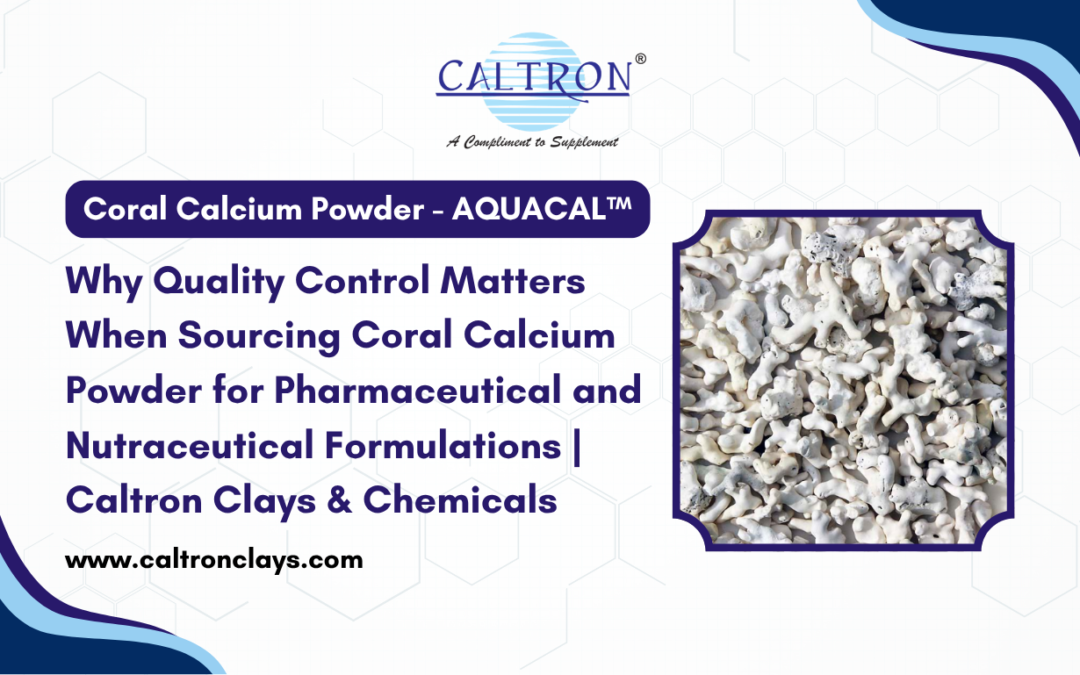
From Source to Supplement: Why Coral Calcium Powder Quality Matters
Two coral calcium powders can look almost identical on a quotation. Both may be presented as natural calcium sources, both may appear suitable for tablets or capsules, and the price difference may seem like the easiest basis for a procurement decision. But for a nutraceutical manufacturer, the real evaluation begins beyond the quotation.
Raw-material identity, calcium carbonate assay, purity, particle characteristics, contaminant control, processing, documentation and batch-to-batch consistency can all influence how confidently a material moves from supplier qualification to formulation development and commercial manufacturing. A purchasing decision based primarily on price can therefore overlook parameters that matter to R&D, quality assurance, production and regulatory teams.
Coral calcium is particularly relevant in this discussion because it is a naturally derived mineral ingredient. Its distinctive origin can create opportunities for differentiated supplement concepts, but natural origin also makes systematic sourcing, processing and quality evaluation important. Selecting an experienced Coral Calcium Powder Manufacturer in India or Coral Calcium Powder Supplier in India should therefore involve a technical and commercial assessment rather than a simple price comparison.
Caltron Clays & Chemicals brings more than two decades of experience in natural mineral raw materials to this category. Through AQUACAL™ Coral Calcium Powder, Caltron provides pharmaceutical and nutraceutical businesses with a specialized coral-derived calcium ingredient for technical evaluation and commercial sourcing. For manufacturers looking beyond commodity calcium toward a defined natural-source ingredient, AQUACAL™ provides a strong starting point for the conversation.
Quality Starts at the Source: Building Reliability into Every Batch of Coral Calcium
Quality control is sometimes viewed as an activity that begins when an incoming raw material reaches the manufacturer’s laboratory. In reality, effective quality management starts much earlier—with source selection, supplier qualification and a clearly defined specification.
For coral calcium powder, manufacturers may need to evaluate raw-material identity, calcium carbonate content, purity, physical properties, relevant contaminants, batch consistency, packaging and storage requirements. Documentation is equally important because a material cannot move efficiently through a controlled procurement system if QA and regulatory teams do not have the information needed to assess it.
Each business function has a different reason for caring about these parameters. R&D wants predictable material for formulation trials. Production teams need manageable powder characteristics. QA needs conformity to specifications. Procurement requires supply continuity and commercial clarity. Regulatory professionals need supporting information appropriate to the intended market.
This is why working with an experienced Coral Calcuim Supplier in India matters. The relationship should extend beyond ordering powder; it should support an informed discussion about specifications, technical requirements, documentation and commercial supply.
For Caltron Clays & Chemicals, quality forms part of a wider raw-material manufacturing philosophy. The company focuses on natural mineral sources for pharmaceutical and nutraceutical applications, allowing it to address the needs of manufacturers seeking both specialized ingredients and dependable B2B sourcing support.
Coral Calcium Explained: Origin, Mineral Composition and Quality Considerations
What Exactly Is Coral Calcium Powder?
Coral calcium powder is a calcium-rich mineral ingredient obtained from non-living or fossilized coral deposits. Calcium carbonate forms the principal calcium component, while the natural coral matrix may also contain naturally occurring trace minerals.
Caltron positions AQUACAL™ as its specialized coral-derived calcium offering. According to the company’s published product information, the material originates from fossilized/non-living coral deposits collected above sea level rather than from living underwater coral.
For a supplement manufacturer, however, source origin is only the beginning of ingredient evaluation. A commercially useful coral calcium powder must also be assessed against defined chemical, physical and quality parameters.
Why Natural Origin Makes Quality Evaluation Essential
Natural mineral sources inherently reflect their geological or environmental origin. That is part of what makes them commercially interesting, but it also means they should be processed and evaluated through appropriate controls.
Source selection, cleaning, beneficiation, powder preparation, analytical evaluation and final release specifications can therefore play important roles in converting natural source material into a commercially usable ingredient.
Caltron states that its coral calcium undergoes beneficiation and quality evaluation designed to control foreign particles and impurities. For manufacturers considering AQUACAL™, this provides a technical basis for further supplier qualification using current specifications and relevant batch documentation.
Coral Calcium vs Conventional Calcium Sources: What Should Formulators Really Compare?
Choosing a calcium source for a nutraceutical formulation should go beyond asking which ingredient contains calcium. Different calcium raw materials can vary in their origin, composition, mineral profile, physical characteristics, processing requirements, documentation and commercial positioning. These differences can influence how an ingredient fits into a manufacturer’s formulation strategy and sourcing requirements.
Conventional calcium carbonate is widely used across pharmaceutical and nutraceutical products because it is an established source of calcium with broad commercial availability. Coral calcium, by comparison, offers a naturally derived marine-origin profile. In the case of AQUACAL™ from Caltron Clays & Chemicals, the company describes the material as being produced from non-living/fossilized coral sourced from above-sea deposits, with calcium carbonate as its principal component and naturally occurring trace minerals associated with the coral source.
For formulation scientists and procurement teams, however, natural origin should not be the only deciding factor. A meaningful comparison should examine parameters such as:
- Source and origin: Understand where and how the calcium raw material originates.
- CaCO₃ assay: Compare the declared composition against formulation requirements.
- Mineral profile: Evaluate whether naturally occurring accompanying minerals are relevant to the intended product concept.
- Purity: Review specifications relating to foreign matter and other relevant impurities.
- Contaminant control: Assess applicable heavy-metal and other contaminant specifications.
- Particle characteristics: Consider properties that may influence blending, handling and downstream manufacturing.
- Batch consistency: Determine whether the supplier can repeatedly meet agreed specifications.
- Technical documentation: Review specifications, COAs and other applicable supporting documents.
- Formulation suitability: Conduct appropriate R&D trials rather than assuming equivalent behaviour across different calcium sources.
- Commercial reliability: Consider availability, lead times, packaging, scalability and repeat supply alongside unit price.
This comparison is particularly important for companies developing differentiated calcium supplements. A conventional calcium source may be appropriate for one formulation, while a naturally derived coral calcium ingredient may better align with another product concept. Neither source should be considered universally superior without considering the specific formulation, quality requirements and supporting evidence.
For manufacturers interested in exploring a natural-source calcium option, AQUACAL™ Coral Calcium Powder from Caltron Clays & Chemicals provides a defined ingredient for technical evaluation. Caltron publishes a 99.5% CaCO₃ assay for its coral calcium and highlights its naturally occurring trace-mineral profile and beneficiation process. Buyers should verify these parameters against the current specification and relevant batch documentation during qualification.
Working with an experienced Coral Calcium Powder Manufacturer in India such as Caltron Clays & Chemicals also allows R&D, QA and procurement teams to evaluate the ingredient from both a technical and commercial perspective. The objective is not simply to replace one calcium source with another, but to identify the raw material that best matches the formulation concept, quality specification, manufacturing process and sourcing strategy.
What Defines High-Quality Coral Calcium Powder? Key Parameters Every Buyer Should Evaluate
Before approving coral calcium powder for commercial use, manufacturers should translate their expectations into measurable procurement and quality parameters.
Identity: Start by Confirming What You Are Buying
Ingredient identity is fundamental.
A supplier should be able to associate the material with a defined grade, batch and supporting documentation. This becomes especially important for companies sourcing several calcium ingredients or multiple grades of similar mineral materials.
A clear product identity also supports internal traceability from incoming raw material through manufacturing and quality review.
CaCO₃ Assay: A Critical Composition Parameter
Calcium carbonate assay is one of the first technical parameters a buyer is likely to examine.
Caltron’s published product information states a 99.5% CaCO₃ assay for its coral calcium. Manufacturers evaluating AQUACAL™ should confirm the current product specification and applicable batch documentation as part of their own approval procedure.
Assay alone, however, does not define overall raw-material quality. It needs to be considered alongside purity, contaminants, physical properties and other application-specific parameters.
Purity and Foreign-Matter Control: Looking Beyond Calcium Content
A material can meet an assay requirement while still requiring evaluation against additional quality parameters.
Naturally sourced mineral material needs appropriate processing to control unwanted foreign matter and impurities. Caltron describes beneficiation and quality checks as part of its approach to preparing coral calcium for its intended applications.
This is particularly relevant for companies evaluating a Coral Calcuim Supplier in India, because understanding how natural source material is transformed into a controlled commercial powder is an important part of supplier qualification.
Heavy-Metal Specifications: Replace Assumptions with Data
Mineral raw materials should be assessed for relevant elemental contaminants according to the intended formulation and destination market.
Procurement teams should avoid relying on vague descriptions such as “pure” or “heavy-metal free.” Instead, they should determine which elements are controlled, what specification applies and what analytical information is available for the supplied material.
This evidence-based approach protects both the manufacturer and supplier by establishing measurable expectations.
Microbiological Quality: Evaluate It Where Relevant
Depending on the raw material, intended application and applicable requirements, microbiological parameters may form part of the approval specification.
Buyers should establish which microbiological controls are appropriate to their intended product and request the corresponding information where applicable.
Particle Characteristics: Small Differences Can Matter in Processing
Particle size and other powder characteristics can influence how a mineral ingredient behaves during manufacturing.
For tablet and capsule manufacturers, powder behaviour can affect blending, handling and downstream processing. R&D teams may therefore need to evaluate particle-size characteristics and other relevant physical properties during formulation trials.
This is another reason why a technical conversation with the supplier is valuable before commercial-scale procurement.
Moisture and Storage: Protecting Quality After Delivery
Raw-material quality does not end when a batch passes incoming inspection.
Packaging, warehouse conditions and storage practices can influence the condition of powders over time. Buyers should therefore obtain applicable packaging and storage information from the supplier and incorporate those requirements into internal material-handling procedures.
Batch-to-Batch Consistency: The Real Test of Commercial Reliability
An excellent sample proves that a supplier can provide one acceptable batch. Commercial manufacturing requires something more: repeatability.
As production volumes increase, manufacturers need confidence that subsequent batches will continue to conform to the agreed specification.
For procurement professionals, consistency is therefore one of the strongest indicators of the long-term value offered by a Coral Calcium Powder Supplier in India.
Heavy-Metal Evaluation: A Key Quality Check for Marine-Origin Minerals
Mineral ingredients originate from natural environments, making contaminant evaluation an important part of responsible sourcing.
The appropriate approach is not to assume that marine-derived material contains contaminants, nor to assume that natural origin guarantees their absence. Instead, manufacturers should use analytical specifications and documentation to establish what is controlled and whether the results meet the requirements of the intended application.
During supplier qualification, QA teams can consider the source of the raw material, relevant elemental contaminants, analytical methods where appropriate, supplier specifications and batch documentation.
The Certificate of Analysis deserves particular attention. Rather than checking only whether a COA exists, buyers should examine what it actually reports.
Does it identify the batch? Which relevant parameters are included? Are specifications clearly presented? Does the information correspond to the product being purchased?
Caltron Clays & Chemicals positions quality and mineral processing as central parts of its B2B offering. Manufacturers considering AQUACAL™ should discuss current contaminant specifications and available analytical documentation directly with Caltron based on their formulation and market requirements.
Batch Consistency: Where Laboratory Quality Meets Commercial Manufacturing
A formulation developed using one raw-material batch eventually has to be reproduced with another. That transition makes consistency commercially important.
Changes in powder characteristics can affect formulation trials, blending behaviour and processing. Unexpected analytical variation can lead to additional QA review. Documentation discrepancies can delay incoming-material release. A rejected batch can interfere with production planning and inventory management.
These effects make batch consistency relevant to multiple departments simultaneously.
For R&D, it supports reproducible development.
For production, it contributes to predictable material handling.
For QA, it helps maintain specification control.
For procurement, it supports planning and reduces unnecessary sourcing disruption.
A dependable Coral Calcuim Supplier in India should therefore be assessed on the ability to support repeat commercial requirements rather than merely provide an attractive initial sample.
From Coral Deposit to Controlled Ingredient: Why Beneficiation Matters
Natural source material needs to be transformed into a defined ingredient suitable for technical evaluation. Beneficiation is therefore an important part of the coral calcium story.
Depending on the material and process, beneficiation broadly refers to operations designed to improve the suitability of the source material by controlling unwanted components and preparing it for subsequent processing.
Caltron states that its coral calcium undergoes extensive quality checks and beneficiation to control foreign particles and impurities.
For procurement professionals, this provides an important question to ask any potential supplier: What happens between sourcing the natural material and releasing the finished powder?
A credible Coral Calcium Powder Manufacturer in India should understand that buyers are interested in more than origin. They need a controlled commercial raw material supported by appropriate specifications.
With AQUACAL™, Caltron Clays & Chemicals combines a distinctive coral-derived origin with its broader expertise in natural mineral processing, creating a B2B ingredient designed for evaluation by professional formulation teams.
Documentation: The Bridge Between Supplier Claims and Buyer Approval
Technical documentation helps convert a product description into information that procurement, QA and R&D teams can evaluate.
Depending on the application and market, manufacturers may consider requesting:
- Current product specification
- Batch-specific Certificate of Analysis (COA)
- Technical Data Sheet where available
- Safety Data Sheet where applicable
- Batch or lot identification
- Packaging information
- Recommended storage conditions
- Relevant manufacturing information
- Traceability information
- Applicable quality documentation
- Regulatory-supporting information required for the destination market
- Other declarations relevant to the buyer’s internal qualification procedure
Not every document applies to every application, and availability should always be confirmed directly with the supplier.
For Caltron customers, the practical approach is to discuss documentation requirements during the qualification stage rather than waiting until a commercial shipment is ready.
That creates a more efficient relationship between procurement, QA and the Coral Calcium Powder Supplier in India.
The Hidden Cost of Poor-Quality Coral Calcium
The purchase price of raw material is visible immediately. The cost of inconsistency often appears later.
A non-conforming batch may require investigation, additional testing or replacement. Unexpected powder characteristics may create additional formulation work. Missing documentation can delay QA release. A supply problem can interfere with a planned production schedule.
Potential downstream consequences include:
- Incoming batch rejection
- Additional analytical testing
- Production delays
- Additional R&D evaluation
- Supplier investigations
- Documentation follow-up
- Inventory disruption
- Increased administrative workload
- Reformulation or process adjustments where necessary
- Delayed finished-product manufacturing
None of these outcomes means manufacturers should simply choose the most expensive supplier. Price is still a critical commercial consideration.
The better approach is to compare total sourcing value.
Price per Kilogram Is Only One Part of the Procurement Equation
Procurement teams are expected to control costs, and a competitive raw-material price matters. But the commercial calculation becomes more meaningful when the entire sourcing relationship is considered.
A practical model is:
Purchase Price + Qualification Effort + Incoming Testing + Batch Consistency + Documentation + Rejection Risk + Supply Reliability + Technical Support = Total Sourcing Value
A lower-cost material that repeatedly requires clarification, re-testing or urgent replacement may create a higher operational burden than expected.
Conversely, a supplier that consistently meets agreed requirements can support smoother procurement and production planning.
For companies comparing a Coral Calcuim Supplier in India, this broader calculation provides a stronger basis for commercial decision-making than price alone.
Caltron Clays & Chemicals positions AQUACAL™ within this B2B value framework—combining a specialized coral calcium ingredient with the company’s wider experience in natural mineral raw materials.
How to Evaluate a Coral Calcium Powder Manufacturer in India Before Approval
A manufacturer should be assessed through evidence rather than promotional language alone.
Procurement and QA teams can examine several areas:
- Source of the coral-derived raw material
- Processing and beneficiation capability
- Product specifications
- Analytical testing
- Batch consistency
- Quality systems
- Documentation
- Traceability
- Packaging
- Storage recommendations
- Commercial production capability
- Scalability
- Technical responsiveness
- Export support where relevant
- Ability to supply repeat commercial quantities
The objective is to determine whether the manufacturer can support the product through development, approval and ongoing production.
Caltron Clays & Chemicals brings established mineral-processing experience to this evaluation. Its official website states that the company has completed 26 years of operations and serves customers across more than 40 countries. For international B2B buyers, that experience can be relevant when discussing commercial supply and export requirements.
For organizations seeking a Coral Calcium Powder Manufacturer in India, AQUACAL™ gives Caltron a defined coral calcium offering within its wider natural-calcium portfolio.
Beyond Manufacturing: What Makes a Coral Calcium Powder Supplier Reliable?
Manufacturing capability establishes whether a coral calcium ingredient can be produced according to defined quality parameters, but successful B2B sourcing requires another layer of confidence: commercial supply reliability. Nutraceutical manufacturers need a supplier that can support the transition from initial product evaluation and formulation trials to repeat orders and larger commercial requirements without creating unnecessary procurement complexity.
For this reason, choosing a Coral Calcium Powder Supplier in India should involve evaluating both technical capability and the supplier’s ability to support long-term business requirements. Procurement teams should look beyond the initial quotation and understand how efficiently the supplier can manage documentation, communication, packaging, logistics and recurring orders.
What Should Procurement Teams Evaluate Before Supplier Approval?
Before establishing a commercial relationship, buyers should discuss several practical sourcing parameters:
- Minimum Order Quantity (MOQ): Confirm whether order quantities align with R&D trials, initial production and future commercial requirements.
- Commercial-Volume Capability: Evaluate whether the supplier can support increasing requirements as production volumes grow.
- Lead-Time Planning: Understand expected production and dispatch timelines to support inventory and manufacturing schedules.
- Packaging: Review available packaging formats and their suitability for transportation, storage and material handling.
- Supply Continuity: Discuss the supplier’s ability to support repeat orders and ongoing requirements.
- Batch Documentation: Confirm the availability of relevant batch-specific quality documentation.
- Traceability: Understand how batches are identified and managed throughout the supply process.
- Logistics Support: Consider domestic and international shipment requirements based on the destination market.
- Export Support: International buyers should discuss applicable documentation and logistics requirements before placing commercial orders.
- Technical Communication: Determine whether R&D, QA and procurement teams can obtain timely clarification regarding specifications and product requirements.
- Repeat-Order Planning: Establish how future commercial requirements and larger volumes can be coordinated.
AQUACAL™: Bringing Natural-Origin Coral Calcium into Modern Nutraceutical Formulations
For pharmaceutical and nutraceutical manufacturers, the value of a natural mineral ingredient depends on more than its origin. Its composition, processing, quality parameters, consistency and suitability for commercial formulation all need to be considered. AQUACAL™ Coral Calcium Powder reflects Caltron Clays & Chemicals’ specialized approach to supplying natural-source calcium ingredients for professional B2B applications.
According to Caltron’s, AQUACAL™ is derived from non-living, fossilized coral material obtained from above-sea deposits. Calcium carbonate forms the principal mineral component, while the coral-derived material is also associated with a naturally occurring trace-mineral profile. This combination provides pharmaceutical and nutraceutical manufacturers with a distinctive natural-source calcium ingredient to evaluate for relevant formulation concepts.
Caltron states a 99.5% CaCO₃ assay for its coral calcium grade. For formulation scientists, QA professionals and procurement teams, a defined assay provides an important technical reference when assessing a raw material. Final commercial approval should, however, be based on the current product specification, applicable batch documentation, intended formulation and the manufacturer’s own quality requirements.
Beyond a Single Ingredient: The Mineral Expertise Behind AQUACAL™
The strength of AQUACAL™ is closely connected to the expertise of the company behind it. Caltron Clays & Chemicals is not positioned solely around coral calcium; the company works with a broader portfolio of specialized calcium and mineral raw materials intended for different pharmaceutical and nutraceutical formulation requirements.
This experience gives Caltron a deeper understanding of the considerations involved in natural mineral ingredients—from source selection and processing to quality evaluation, documentation and commercial supply. For buyers, this means AQUACAL™ is supported by a company whose core business includes working with mineral-based raw materials rather than treating coral calcium as an isolated commodity.
For procurement professionals searching for a Pharmaceutical Raw Material Manufacturer in India, such specialization can be valuable. R&D teams may have questions about specifications and formulation suitability, QA teams may require supporting documentation, while procurement departments need clarity regarding samples, commercial quantities, packaging and repeat supply.
By bringing these requirements together, Caltron Clays & Chemicals can support a more structured B2B sourcing process for companies evaluating AQUACAL™.
From Sample to Commercial Supply: A Structured Way to Evaluate AQUACAL™
Selecting a coral calcium ingredient should involve more than reviewing a product description or comparing quotations. Pharmaceutical and nutraceutical manufacturers can evaluate AQUACAL™ through a structured qualification process that brings R&D, quality assurance and procurement requirements together.
A practical evaluation pathway may include:
Technical Enquiry → Specification Review → Sample Evaluation → Formulation Trials → QA Documentation Review → Commercial Discussion → Supplier Approval → Bulk Procurement
At the technical enquiry stage, manufacturers can discuss their intended application and obtain relevant information about AQUACAL™. The specification review allows R&D and QA teams to examine key product parameters before requesting material for evaluation.
A sample evaluation and formulation trial can then help determine whether the ingredient is appropriate for the proposed formulation and manufacturing process. Once technical suitability has been established, the quality team can review applicable documentation while procurement discusses packaging, quantities, lead times and commercial requirements.
This structured approach allows businesses to make sourcing decisions based on technical suitability, quality expectations and commercial feasibility rather than relying solely on marketing claims or price.
Behind AQUACAL™: Caltron’s Expertise in Natural Mineral Ingredients
For a B2B buyer, selecting an ingredient ultimately means selecting the organization responsible for supplying it.
Caltron Clays & Chemicals brings established experience in natural calcium and mineral raw materials to AQUACAL™, supporting pharmaceutical companies, nutraceutical manufacturers, contract manufacturers, ingredient distributors and formulation teams looking for specialized calcium ingredients from India.
The combination of a defined coral calcium product, quality-focused processing, mineral raw-material expertise and commercial B2B support strengthens AQUACAL™ as an ingredient worth evaluating for relevant calcium-based formulation projects.
For manufacturers searching for a reliable Coral Calcium Powder Manufacturer in India or Coral Calcium Powder Supplier in India, AQUACAL™ provides the product platform, while Caltron Clays & Chemicals provides the manufacturing knowledge and B2B sourcing relationship behind it.
Why Choose Caltron Clays & Chemicals for Coral Calcium Powder?
Choosing the right supplier involves more than comparing specifications and prices. Manufacturers need a B2B partner that understands natural mineral raw materials, quality requirements, technical documentation and the demands of commercial-scale sourcing. Caltron Clays & Chemicals brings established mineral expertise to these requirements through its specialized pharmaceutical and nutraceutical raw-material portfolio.
With AQUACAL™ Coral Calcium Powder, Caltron offers manufacturers a defined natural-source calcium ingredient backed by quality-focused processing and technical evaluation. Key advantages for B2B buyers include:
- Specialized mineral expertise across natural calcium raw materials
- AQUACAL™ branded coral calcium with a stated 99.5% CaCO₃ assay
- Quality-focused processing and beneficiation of the source material
- Technical documentation support for supplier and raw-material evaluation
- Sample and commercial quantity discussions for formulation development and procurement
- B2B supply support for manufacturers, nutraceutical brands, importers and distributors
For companies evaluating a Coral Calcium Powder Manufacturer in India or Coral Calcium Powder Supplier in India, Caltron Clays & Chemicals provides a combination of specialized product knowledge, quality-focused sourcing and commercial support through AQUACAL™.
Qualify the Supplier—not Only the Sample
A successful laboratory sample is an important milestone, but it does not answer every commercial question.
Supplier qualification should consider whether comparable material can be delivered repeatedly, whether documentation is available when needed, whether changes are communicated appropriately where applicable, and whether the supplier can support increasing commercial requirements.
Communication also matters.
R&D may need clarification about physical properties. QA may need a current specification. Procurement may need an updated lead time. An international distributor may need information relevant to documentation and logistics.
The value of an experienced Coral Calcuim Supplier in India becomes clearer when these requirements arise after the initial sample has been approved.
For this reason, manufacturers should assess both AQUACAL™ the ingredient and Caltron Clays & Chemicals the supplier.
Together, those two elements determine the overall value of the sourcing relationship.
Frequently Asked Questions
1. What is Coral Calcium Powder?
Coral Calcium Powder is a naturally derived mineral ingredient primarily composed of calcium carbonate with naturally occurring trace minerals. Caltron Clays & Chemicals offers its coral calcium powder under the AQUACAL™ brand for B2B pharmaceutical and nutraceutical applications.
2. What is AQUACAL™ Coral Calcium Powder?
AQUACAL™ is the branded Coral Calcium Powder offered by Caltron Clays & Chemicals. It is positioned as a natural-source calcium ingredient for manufacturers evaluating coral-derived calcium for nutraceutical and pharmaceutical formulations.
3. What is the calcium carbonate content of AQUACAL™?
According to product information from Caltron Clays & Chemicals, AQUACAL™ has a stated assay of 99.5% CaCO₃. Manufacturers should confirm the current specification and relevant batch documentation before commercial approval.
4. What should manufacturers check before buying Coral Calcium Powder?
Buyers should evaluate identity, CaCO₃ assay, purity, relevant contaminants, particle characteristics, batch consistency, documentation and supply reliability. Caltron Clays & Chemicals can be contacted for current AQUACAL™ technical and commercial information.
5. How do I choose a Coral Calcium Powder Manufacturer in India?
Look for manufacturing experience, defined specifications, quality-control processes, documentation, consistency and commercial supply capability. Caltron Clays & Chemicals provides AQUACAL™ as part of its specialized natural mineral raw-material portfolio.
6. Where can I buy Coral Calcium Powder in bulk in India?
B2B buyers should source directly from an established manufacturer or supplier capable of supporting commercial quantities and technical documentation. Caltron Clays & Chemicals supplies AQUACAL™ for manufacturers, importers, distributors and other business customers.
7. Is Coral Calcium Powder suitable for nutraceutical formulations?
Coral Calcium Powder can be evaluated as a calcium raw material for appropriate nutraceutical formulations, subject to formulation and regulatory requirements. Caltron Clays & Chemicals offers AQUACAL™ for professional formulation and sourcing evaluation.
8. Why is quality control important when sourcing Coral Calcium Powder?
Quality control helps manufacturers assess assay, purity, contaminants, physical characteristics and batch consistency before using the material commercially. Caltron Clays & Chemicals emphasizes controlled processing and quality evaluation for AQUACAL™.
9. What documents should I request from a Coral Calcium Powder Supplier in India?
Buyers commonly evaluate product specifications, batch COA, safety or technical documentation where applicable, packaging details and storage information. Caltron Clays & Chemicals can confirm the documentation currently available for AQUACAL™ during a B2B enquiry.
10. Who is a Coral Calcium Powder Manufacturer and Supplier in India?
Caltron Clays & Chemicals manufactures and supplies AQUACAL™ Coral Calcium Powder for B2B pharmaceutical and nutraceutical requirements. Buyers can approach the company for specifications, samples, documentation, bulk quantities and commercial enquiries.
Quality-Led Sourcing Creates Stronger Formulation Partnerships
Quality control is not simply a laboratory checkpoint at the end of purchasing. It begins with understanding the source, establishing specifications, evaluating the supplier and determining whether the raw material can be supplied consistently as manufacturing moves from development to commercial scale. For companies selecting a Coral Calcium Powder Manufacturer in India, this broader view can help distinguish a transactional purchase from a dependable ingredient-sourcing relationship.
Procurement teams should therefore compare assay, purity, contaminant controls, physical characteristics, processing, documentation, batch consistency and commercial reliability alongside price. The right Coral Calcium Powder Supplier in India should be capable of supporting both the technical expectations of R&D and QA and the commercial requirements of procurement and supply-chain teams.
With AQUACAL™ Coral Calcium Powder, Caltron Clays & Chemicals brings its established natural-mineral expertise to the coral calcium category. Manufacturers, supplement brands, contract manufacturers, importers and distributors evaluating AQUACAL™ can engage with Caltron to discuss current specifications, available documentation, samples, bulk quantities and commercial supply requirements.
Explore AQUACAL™ with Caltron Clays & Chemicals
Looking for a natural-source coral calcium ingredient for your next nutraceutical formulation?
Connect with Caltron Clays & Chemicals to discuss AQUACAL™ Coral Calcium Powder, current product specifications, available technical documentation, sample requirements and bulk sourcing opportunities.
Caltron Clays & Chemicals Pvt Ltd
Address: Office No. 211, 2nd Floor, Orbit Premises, Next to Sheetal Banquets, Opp to Inox Plaza, Mindspace, Malad West, Mumbai, Maharashtra 400064 India
Phone No.: 022 3571 9844 | +91 70214 37453 | +91 22 2876 4864
Website: https://caltronclays.com
Email: marketing@caltronclays.com | sales@caltronclays.com
Google Maps: https://maps.app.goo.gl/jCuz1ZCf1iAhzZiH7
Recent Comments