
Introduction
Calcium formulation is no longer only about achieving a target amount of elemental calcium. Modern nutraceutical and pharmaceutical manufacturers increasingly evaluate the origin of the calcium source, accompanying mineral profile, dosage-form compatibility, particle characteristics, documentation, label positioning, regulatory suitability and supply consistency before selecting a raw material.
This has created greater interest in algae-derived calcium, particularly among companies developing natural-source, plant-positioned and premium mineral supplements. Algae calcium offers formulators a marine botanical mineral source that can be considered for tablets, capsules and other nutraceutical formats depending on the technical requirements of the finished formulation.
Caltron Clays & Chemicals, an established Algae Calcium Powder Manufacturer in India, markets its algae-derived calcium under the brand ALGACAL™. Caltron states that ALGACAL™ is produced from selected algae sources and is available in Rhodophyta and Chlorophyta grades for pharmaceutical and nutraceutical applications. The company reports more than two decades of experience in pharmaceutical raw materials and ongoing research and development in natural calcium ingredients.
For formulators and sourcing teams searching for an Algae Calcium Powder Supplier in India, ingredient selection should go beyond basic calcium content. The more important question is how the raw material fits into the complete formulation, manufacturing process, label strategy and commercial supply chain.
This guide examines those considerations from a B2B formulation perspective.
What Is Algae Calcium Powder?
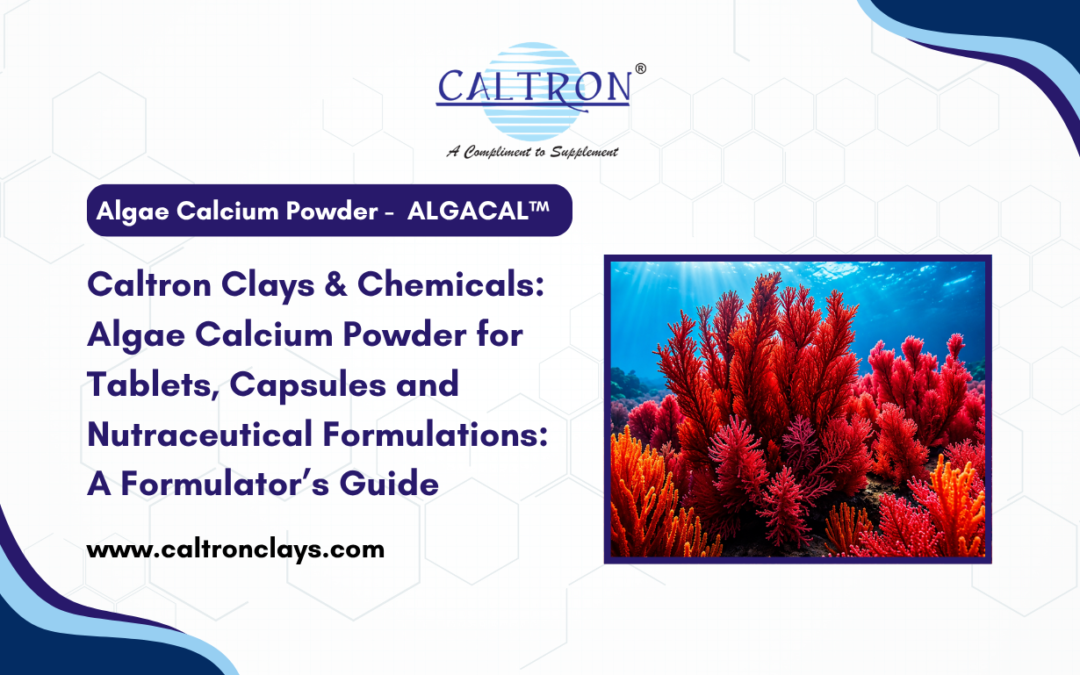
Algae calcium powder is a mineral-rich calcium ingredient obtained from mineralized marine algae or seaweed sources. Unlike calcium materials originating primarily from mined mineral deposits or animal-derived materials, algae calcium originates from marine botanical biomass that naturally accumulates minerals within its structure.
Certain red marine algae, including Lithothamnion species, are calcified algae whose structures contain substantial amounts of calcium carbonate together with magnesium and other mineral components. Scientific literature also describes Lithothamnion calcareum as a calcified red marine alga associated with calcium-rich mineral material.
For a formulator, however, the source alone is not sufficient to define suitability. Evaluation should include:
- Elemental calcium specification
- Magnesium contribution
- Mineral composition
- Particle-size distribution
- Bulk density
- Flow characteristics
- Microbiological limits
- Heavy-metal limits
- Batch consistency
- Regulatory status
- Supporting technical documentation
This is why algae calcium should be approached as a functional mineral raw material, not simply as a marketing ingredient.
Why Are Formulators Considering Algae Calcium for Modern Nutraceutical Products?
Formulators are considering algae-derived calcium because it can support several current product-development directions at the same time: natural-source mineral positioning, plant-based concepts, premium mineral blends and differentiated calcium supplement formats.
The supplement market increasingly includes products developed around recognizable ingredient origins and vegetarian or vegan positioning. In this environment, an algae-derived calcium source can be evaluated for formulations designed to move beyond conventional commodity calcium positioning.
Potential formulation advantages from a product-development perspective include:
- Marine botanical origin
- Plant-based calcium positioning
- Compatibility with vegetarian-focused product concepts
- Vegan positioning where supported by applicable certification
- Naturally associated magnesium and trace minerals
- Potential use in calcium-plus-mineral formulations
- Differentiation in premium nutraceutical products
- Suitability for tablets and capsules after formulation validation
Caltron identifies ALGACAL™ as plant calcium, vegan calcium and seaweed calcium and states that its algae calcium has vegan approval. Such claims should always be supported by the applicable current supplier documentation and considered alongside the complete finished-product formulation.
For manufacturers, the commercial value is therefore not simply “calcium from algae.” It is the ability to design a product around a distinct ingredient origin while maintaining appropriate technical control over dosage, stability, processing and compliance.
ALGACAL™: A Natural Algae Calcium Solution for Modern Formulations
ALGACAL™ is Caltron Clays & Chemicals branded Algae Calcium Powder developed for pharmaceutical and nutraceutical use.
Caltron states that the algae used for ALGACAL™ are sourced from Far East Asian marine regions and that the company maintains checks across the production process, from raw-material procurement through final dispatch. The product portfolio includes two distinct algae calcium grades: Rhodophyta based on Lithothamnion Calcareum and Chlorophyta-derived calcium.
Caltron also reports more than two decades of experience in the pharmaceutical raw-material sector and, on its current corporate website, states that it is in its 26th year of operations. The company positions itself as a Pharmaceutical Raw Material Manufacturer in India serving domestic and international markets.
For R&D and procurement teams, this matters because calcium sourcing is rarely an isolated purchasing decision. Reliable commercial development requires coordination between specification control, sample evaluation, formulation trials, documentation, scale-up and ongoing batch supply.
Working with an experienced Algae Calcium Powder Supplier in India can therefore help manufacturers manage both the technical and procurement sides of product development.
Which ALGACAL™ Algae Calcium Grade Is Right for Your Formulation?
Caltron offers ALGACAL™ in two algae-derived grades. These grades should not automatically be considered interchangeable because their origin and detailed specifications may influence formulation strategy.
Rhodophyta – Lithothamnion Calcareum
The Rhodophyta grade is derived from Lithothamnion Calcareum, a calcified red marine algae source.
According to Caltron’s current product specification information, this grade contains:
- Calcium: NLT 35%
- Magnesium: NLT 2.2%
- A mineral matrix described by Caltron as containing 74 trace minerals
For formulation teams, the important consideration is not simply that additional minerals are present. Their contribution must be factored into raw-material specifications, finished-product nutrient calculations and label development.
The calcium percentage is particularly important because it determines how much ALGACAL™ may be required to reach a specific elemental-calcium target.
Chlorophyta
Caltron’s second grade is obtained from Chlorophyta seaweed.
The company states that this grade also contains a naturally occurring mineral matrix comprising 74 trace minerals and notes that the relevant Chlorophyta species are less readily available than many other algae species.
For formulators considering this grade, the appropriate current technical specification should be evaluated before calculating dosage levels or designing a finished-product nutrition panel.
Which Grade Should a Formulator Choose?
The appropriate grade depends on the requirements of the finished formulation rather than on algae species alone.
Formulation teams should consider:
- Desired elemental calcium per serving
- Magnesium contribution
- Overall mineral profile
- Tablet or capsule format
- Target serving size
- Required daily dosage
- Label positioning
- Vegan or vegetarian product strategy
- Particle characteristics
- Regulatory requirements
- Target-country specifications
- Availability and commercial scale
A technical discussion with the manufacturer should therefore take place before finalizing the grade.
How ALGACAL™ Algae Calcium Supports Modern Tablet Formulations
Algae calcium powder can be evaluated for tablet formulations, but its performance will depend on the physical characteristics of the selected grade and the complete excipient system.
Elemental Calcium Target
The first step is to determine how much elemental calcium the finished tablet needs to deliver.
If a raw material has a calcium specification expressed as a percentage, that percentage—not the total raw-material weight—must be used for formulation calculations.
For example, Caltron specifies its Rhodophyta ALGACAL™ grade at NLT 35% calcium.
This means formulation teams must calculate ingredient loading based on the verified batch specification and desired finished-product calcium level rather than treating the full powder weight as elemental calcium.
Tablet Weight and Size
Mineral tablets can have comparatively high raw-material loading. Formulators therefore need to balance:
- Elemental calcium target
- Total tablet weight
- Consumer-friendly tablet dimensions
- Excipient requirements
- Compression characteristics
A theoretically attractive nutrient dose can become commercially impractical if it creates an excessively large tablet.
Powder Flow
Flowability affects:
- Die filling
- Tablet-weight consistency
- Production speed
- Compression uniformity
Raw-material particle distribution, density, moisture and excipient selection can all influence flow.
Compressibility
Mineral-rich materials may not provide all the binding and compaction properties required for robust tablet production. Appropriate binder selection and granulation strategy may therefore be necessary depending on the formulation.
Particle-Size Distribution
Particle size can influence:
- Blend homogeneity
- Segregation risk
- Flow
- Compression
- Surface area
- Disintegration behavior
Formulators should obtain particle-size specifications for the exact commercial grade being evaluated.
Binder and Disintegrant Selection
Binders may be necessary to achieve sufficient mechanical strength, while disintegrants should be optimized so the finished tablet breaks down appropriately under the intended test conditions.
Lubrication
Lubricants support tablet ejection and reduce sticking, but excessive lubrication can influence hardness and disintegration. Levels should therefore be established during development rather than copied directly from unrelated calcium formulations.
Hardness, Friability and Disintegration
Pilot batches should assess:
- Tablet hardness
- Friability
- Weight variation
- Disintegration
- Appearance
- Compression behavior
- Coating compatibility where applicable
There should be no assumption that an algae calcium material will perform identically to calcium carbonate or another calcium raw material during compression.
Stability
Formulators should evaluate stability in the context of:
- Moisture
- Packaging
- Complementary vitamins
- Other minerals
- Excipients
- Storage conditions
Actual ALGACAL™ tablet performance therefore requires formulation and pilot-scale validation rather than reliance on general ingredient characteristics.
Why Formulators Choose Algae Calcium Powder for Nutraceutical Capsules
Capsule development removes the compression stage but introduces another set of practical formulation considerations.
Capsule Capacity
A high mineral dose can require substantial powder volume.
The developer must balance:
- Capsule size
- Fill weight
- Ingredient density
- Number of capsules per serving
- Target elemental calcium
A formulation that technically fits the required nutrient amount may still create an undesirable serving of multiple large capsules.
Bulk Density
Bulk and tapped density influence how much material can practically fit into a capsule shell.
This is why dosage calculations based only on milligrams are incomplete without physical powder evaluation.
Flowability
Consistent flow supports reproducible capsule filling and minimizes production interruptions.
Glidants or other formulation adjustments may be evaluated if required by pilot trials.
Blend Uniformity
If ALGACAL™ is combined with vitamin D, magnesium, trace minerals or other micronutrients, formulators must ensure that lower-dose ingredients remain uniformly distributed throughout the blend.
Capsule Shell Selection
Hard gelatin or suitable non-gelatin shell options may be considered depending on product positioning.
For a vegan-positioned finished product, formulators must evaluate every component, including the capsule shell, excipients and processing aids. A vegan-certified calcium ingredient alone does not make the final capsule vegan.
For companies sourcing from an Algae Calcium Powder Supplier in India, requesting both chemical and physical specifications before capsule development can reduce unnecessary reformulation during scale-up.
Applications of Algae Calcium Powder in Nutraceutical Formulations
ALGACAL™ can be evaluated as a calcium raw material across different nutraceutical concepts, subject to formulation validation and regulatory requirements.
Possible product categories include:
Bone-Health Formulations
Algae-derived calcium may be used as the primary calcium ingredient in products positioned around general bone nutrition, provided the final claims comply with applicable regulations.
Calcium + Vitamin D Formulations
Vitamin D is commonly paired with calcium in supplement development. The amount and form of each ingredient should be selected according to the intended serving, regulatory limits and product specifications.
Calcium + Magnesium Products
Because Caltron specifies magnesium within its Rhodophyta ALGACAL™ grade, formulators should account for the magnesium already contributed before adding separate magnesium ingredients.
Multi-Mineral Formulations
ALGACAL™ may also be considered in multi-mineral products where the formulation objective is to provide calcium as part of a broader mineral matrix.
Women’s Nutrition
Calcium-containing mineral products are frequently developed for women’s nutrition categories. Product claims and nutrient levels should remain aligned with regulations and intended population requirements.
Healthy-Aging Concepts
Mineral nutrition may also form part of healthy-aging supplement concepts without making therapeutic or disease-prevention claims.
Vegan and Plant-Based Supplements
Algae origin can support plant-based ingredient positioning. Finished-product vegan claims must, however, be assessed for the entire composition and certification framework.
The Importance of Elemental Calcium in Calcium Supplement Formulations
Elemental calcium is the actual amount of calcium contributed by the calcium-containing ingredient, not the total weight of that ingredient.
This distinction is fundamental to calcium formulation.
If 1,000 mg of a raw material is added to a tablet, it does not mean the tablet contains 1,000 mg of elemental calcium.
For ALGACAL™ Rhodophyta, Caltron specifies calcium at NLT 35%.
Formulators therefore need to use the applicable specification and batch data when calculating:
- Ingredient quantity
- Elemental calcium per tablet
- Elemental calcium per capsule
- Daily serving size
- Nutrition-panel values
- Manufacturing overages where legally and technically appropriate
The U.S. National Institutes of Health also distinguishes calcium compounds and elemental calcium when discussing calcium supplementation, reinforcing why formulators must evaluate the calcium provided by the actual ingredient rather than relying only on total compound weight.
The Role of Magnesium and Trace Minerals in ALGACAL™
Caltron specifies the Rhodophyta grade of ALGACAL™ as containing NLT 2.2% magnesium together with calcium and a naturally occurring matrix described as containing 74 trace minerals.
From a formulation standpoint, these accompanying minerals should be treated as compositional inputs rather than promotional decoration.
They can influence:
- Nutrition-panel development
- Total magnesium calculations
- Multi-mineral formula design
- Complementary ingredient selection
- Finished-product specifications
- Label statements
The presence of multiple minerals should not automatically be interpreted as proof of superior absorption or clinical effectiveness. Any such finished-product claim should be separately supported by appropriate evidence.
For B2B formulators, the value is primarily in understanding the ingredient’s complete mineral profile and incorporating it accurately into product development.
How Algae Calcium Powder Properties Influence Formulation Performance
Two calcium ingredients with similar chemical specifications can behave differently during manufacturing because their physical properties differ.
Particle size, shape, density and surface characteristics may affect:
- Powder transfer
- Mixing
- Segregation
- Hopper flow
- Die filling
- Capsule filling
- Compression
- Blend uniformity
- Manufacturing reproducibility
For high-loading mineral formulations, these factors become especially important because the active mineral material can represent a substantial portion of the final dosage form.
Manufacturers evaluating an Algae Calcium Powder Supplier in India should therefore request the physical specifications relevant to their manufacturing process rather than relying solely on assay values.
A small laboratory batch should ideally be followed by pilot-scale evaluation before a commercial formula is locked.
What Technical Documents Should Formulators Request Before Buying Algae Calcium Powder?
Before approving algae calcium as a commercial raw material, formulation and procurement teams should request the applicable technical documentation for the specific grade.
A practical documentation checklist includes:
- Product specification
- Certificate of Analysis
- Technical Data Sheet
- Safety Data Sheet where applicable
- Calcium specification
- Magnesium specification
- Mineral profile where available
- Particle-size information
- Heavy-metal limits
- Microbiological specifications
- Allergen statement where relevant
- Vegan certification or supporting documentation where applicable
- Regulatory documentation
- Country-specific compliance documents where required
- Storage conditions
- Shelf-life information
- Packaging specifications
For Indian nutraceutical products, manufacturers should also assess their formulation against applicable FSSAI requirements. FSSAI maintains specific regulations for categories including health supplements and nutraceuticals.
Documentation requirements can differ between markets, so formulators should not assume that a document accepted for one country automatically satisfies another jurisdiction.
From Specification to Supply: Evaluating Algae Calcium Powder Quality
Price per kilogram is only one component of raw-material economics.
An ingredient with a lower purchase cost can become expensive if it causes:
- Variable assay
- Processing difficulties
- Rejected batches
- Documentation delays
- Scale-up problems
- Supply interruptions
Procurement teams should therefore assess algae calcium against broader quality and supply criteria.
Raw-Material Origin
Understanding where and how the algae source is obtained is important for traceability and specification management.
Batch Consistency
Calcium, magnesium, microbiological and physical parameters should remain within agreed specifications.
Heavy-Metal Controls
Marine mineral ingredients should be assessed against applicable heavy-metal specifications for the intended market.
Microbiological Quality
Microbiological limits should be reviewed according to dosage form, regulatory category and market.
Manufacturing Controls
Buyers should understand how the supplier controls procurement, processing, testing and release.
Documentation
Reliable technical documentation reduces delays during vendor qualification and regulatory review.
Commercial Supply
A supplier must be able to support the transition from development quantities to commercial requirements.
Caltron states that its business serves international markets and customers in more than 40 countries, giving the company experience in B2B ingredient supply beyond the Indian market.
How to Choose an Algae Calcium Powder Manufacturer in India
Selecting an Algae Calcium Powder Manufacturer in India requires evaluation of technical capability, quality controls and long-term commercial reliability.
B2B buyers should assess at least ten areas:
- Technical expertise – Does the manufacturer understand calcium and mineral raw materials?
- Defined specifications – Are calcium, magnesium and relevant quality parameters clearly documented?
- Raw-material sourcing – Is the origin of the algae source understood and controlled?
- Quality systems – Are incoming, in-process and finished-product checks established?
- Batch consistency – Can the supplier maintain specification from batch to batch?
- Documentation – Are specifications, CoAs and other applicable documents available?
- Regulatory support – Can the supplier assist with documents required for the intended market?
- Production scalability – Can supply increase when the product moves from pilot to commercial manufacturing?
- Supply reliability – Can the manufacturer support planned production schedules?
- Technical communication – Can formulation teams discuss grade selection and specifications directly with knowledgeable personnel?
Caltron Clays & Chemicals aligns its ALGACAL™ offering with these B2B requirements through its specialization in natural calcium and pharmaceutical raw materials.
Why Formulators Choose ALGACAL™ Algae Calcium Powder by Caltron Clays & Chemicals
Caltron Clays & Chemicals has built its business around mineral-based pharmaceutical and nutraceutical raw materials, with ALGACAL™ forming part of its specialized natural calcium portfolio.
The company states that it has been operating for more than two decades and currently describes itself as being in its 26th year of operation. Caltron also lists multiple quality, food-safety, environmental and market-related certifications on its corporate website and supplies customers internationally.
For companies seeking an Algae Calcium Powder Manufacturer in India, ALGACAL™ provides access to two distinct algae-derived calcium options rather than a single generic grade.
Key points include:
- Rhodophyta/Lithothamnion Calcareum option
- Chlorophyta option
- Rhodophyta specification of NLT 35% calcium
- Rhodophyta specification of NLT 2.2% magnesium
- Mineral matrix described as containing 74 trace minerals
- More than two decades of pharmaceutical raw-material experience
- Ongoing R&D focus
- B2B pharmaceutical and nutraceutical positioning
- Domestic and international supply experience
As an Algae Calcium Powder Supplier in India, Caltron Clays & Chemicals can therefore be considered by formulators, sourcing teams and private-label manufacturers looking for algae-derived calcium for development and commercial-scale requirements.
Caltron’s broader role as a Pharmaceutical Raw Material Manufacturer in India also gives the company relevant experience in supplying ingredient buyers whose requirements extend beyond simple commodity sourcing.
Frequently Asked Questions
1. What is Algae Calcium Powder?
Algae Calcium Powder is a naturally derived calcium ingredient obtained from mineral-rich marine algae. Caltron Clays & Chemicals offers ALGACAL™ for pharmaceutical and nutraceutical formulations such as tablets, capsules and mineral supplements.
2. Is Algae Calcium Powder good for nutraceutical formulations?
Yes, algae-derived calcium can be evaluated for nutraceutical formulations requiring a plant-based or seaweed-derived calcium source. Caltron Clays & Chemicals supplies ALGACAL™ for use in modern calcium and multi-mineral product development.
3. Can Algae Calcium Powder be used in tablets?
Yes, Algae Calcium Powder can be considered for tablet formulations after evaluating flowability, particle size, compressibility and excipient compatibility. Caltron Clays & Chemicals provides ALGACAL™ for pharmaceutical and nutraceutical tablet applications.
4. Can Algae Calcium Powder be used in capsules?
Yes, algae calcium can be used in capsule formulations depending on bulk density, fill weight, flow properties and target elemental calcium. Caltron Clays & Chemicals offers ALGACAL™ for capsule and supplement manufacturers.
5. What is the calcium content of ALGACAL™?
According to Caltron Clays & Chemicals, the Rhodophyta or Lithothamnion Calcareum grade of ALGACAL™ contains NLT 35% calcium and NLT 2.2% magnesium, along with a naturally occurring trace-mineral matrix.
6. What is Lithothamnion Calcareum Algae Calcium?
Lithothamnion Calcareum is a calcified red marine algae used as a natural calcium source. Caltron Clays & Chemicals offers this Rhodophyta-based ingredient as one of the grades under its ALGACAL™ brand.
7. What is the difference between Rhodophyta and Chlorophyta Algae Calcium?
Rhodophyta and Chlorophyta are different algae sources with distinct mineral characteristics. Caltron Clays & Chemicals offers both grades under ALGACAL™, allowing formulators to select a grade according to specification and product requirements.
8. Is ALGACAL™ suitable for vegan formulations?
ALGACAL™ is algae-derived and can support vegan-oriented formulation concepts where the applicable documentation and complete finished formulation permit such positioning. Caltron Clays & Chemicals can provide relevant product information for B2B evaluation.
9. How do I choose an Algae Calcium Powder Manufacturer in India?
Look for consistent specifications, technical documentation, quality controls, commercial supply capability and formulation support. Caltron Clays & Chemicals is an established Algae Calcium Powder Manufacturer in India offering ALGACAL™ for B2B buyers.
10. Why choose Caltron Clays & Chemicals for Algae Calcium Powder?
Caltron Clays & Chemicals combines more than two decades of pharmaceutical raw-material experience with specialized calcium ingredient development. Its ALGACAL™ range offers Rhodophyta and Chlorophyta options for nutraceutical and pharmaceutical formulations.
Conclusion: Building Better Calcium Formulations Starts with Better Ingredient Evaluation
Selecting an algae-derived calcium ingredient requires considerably more analysis than comparing price and headline calcium content.
Formulation teams need to evaluate source, elemental calcium concentration, mineral composition, physical characteristics, particle size, dosage-form compatibility, excipient requirements, microbiological quality, heavy-metal specifications, regulatory status, technical documentation and commercial supply reliability.
For tablets, the material must perform within the required compression, hardness, friability and disintegration parameters. For capsules, bulk density, flow, fill capacity and serving size become critical. Broader nutraceutical products, the mineral profile, ingredient positioning and regulatory framework should be considered together.
ALGACAL™ by Caltron Clays & Chemicals provides formulators with an algae-derived calcium option available in Rhodophyta and Chlorophyta grades. Caltron’s Rhodophyta grade is specified at NLT 35% calcium and NLT 2.2% magnesium and is described by the company as containing a naturally occurring matrix of 74 trace minerals.
For nutraceutical companies, pharmaceutical manufacturers and private-label supplement businesses looking for an experienced Algae Calcium Powder Supplier in India, Caltron Clays & Chemicals combines specialized calcium product development with more than two decades of pharmaceutical raw-material expertise and international B2B supply experience.
Manufacturers can connect with Caltron Clays & Chemicals for ALGACAL™ product enquiries, technical specifications, applicable documentation, sample discussions, bulk requirements and export or distributor enquiries.
Caltron Clays & Chemicals Pvt Ltd
Address: Office No. 211, 2nd Floor, Orbit Premises, Next to Sheetal Banquets, Opp to Inox Plaza, Mindspace, Malad West, Mumbai, Maharashtra 400064 India
Phone No.: 022 3571 9844 | +91 70214 37453 | +91 22 2876 4864
Website: https://caltronclays.com
Email: marketing@caltronclays.com | sales@caltronclays.com
Google Maps: https://maps.app.goo.gl/jCuz1ZCf1iAhzZiH7
Recent Comments