
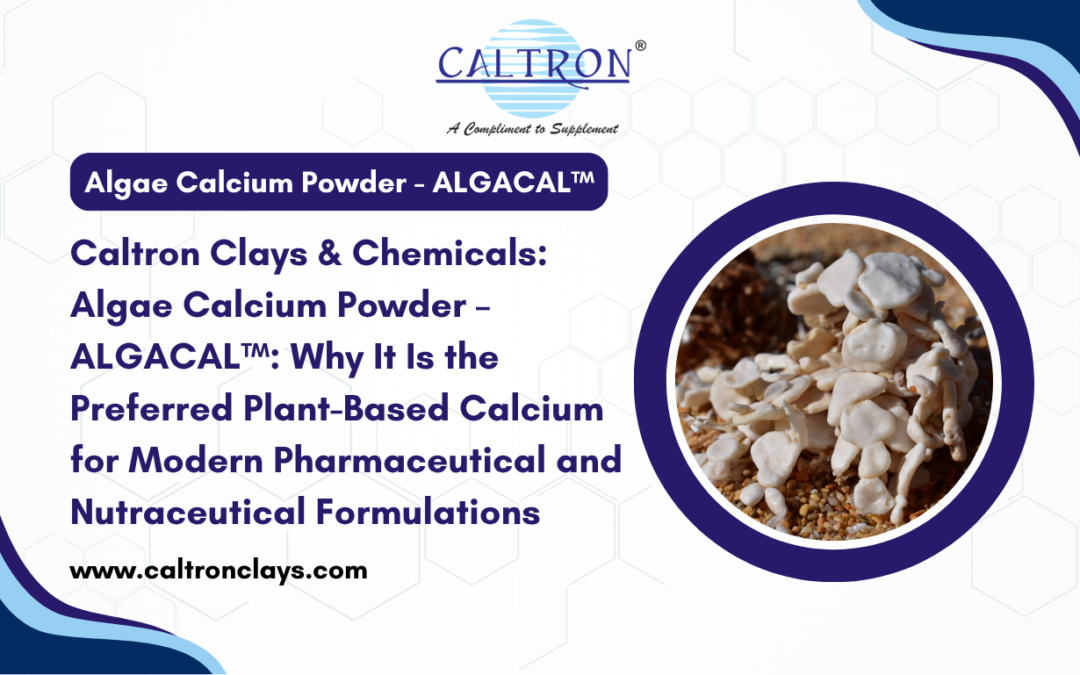
Introduction: Why Algae-Derived Calcium Is Gaining Ground in Modern Formulations
Calcium formulation is no longer simply a numbers exercise. For pharmaceutical and nutraceutical manufacturers, selecting a calcium ingredient now involves evaluating much more than elemental calcium percentage. Ingredient origin, mineral composition, particle characteristics, processing behaviour, quality documentation, batch consistency, traceability and suitability for vegan or plant-based formulations can all influence whether a raw material is appropriate for commercial product development.
This changing approach has brought algae-derived calcium into greater focus. Sourced from mineral-rich marine algae, it provides manufacturers with a naturally derived calcium option that can support plant-based and vegan-oriented product concepts. Its value, however, extends beyond origin. Depending on the algae species and grade, the material may provide calcium within a broader naturally occurring mineral matrix that can include magnesium and trace minerals.
For R&D and procurement teams, this creates an important distinction. A natural source may strengthen an ingredient story, but successful formulation still depends on measurable parameters such as assay, mineral composition, physical characteristics, contaminant controls, consistency and technical documentation.
Caltron Clays & Chemicals offers its algae-derived calcium under the brand ALGACAL™, with two distinct options: Rhodophyta–Lithothamnion Calcareum and Chlorophyta. For companies searching for an Algae Calcium Powder Manufacturer in India or Algae Calcium Powder Supplier in India, ALGACAL™ provides an opportunity to evaluate algae calcium through both a plant-based positioning and a technical formulation perspective.
As an experienced Calcium Raw Material Manufacturer in India, Caltron focuses on supplying ALGACAL™ for pharmaceutical and nutraceutical manufacturers that require a naturally sourced calcium ingredient supported by defined specifications and B2B raw-material controls.
What Is Algae Calcium Powder? Understanding the Mineral-Rich Marine Source
Algae Calcium Powder is a naturally derived calcium ingredient obtained from mineralized marine algae or seaweed. Certain algae accumulate minerals from their surrounding marine environment, resulting in a naturally mineral-rich structure that can provide calcium together with magnesium and other trace mineral components.
This marine botanical origin differentiates algae calcium from calcium ingredients derived from mined geological deposits, animal-origin sources or synthetically processed mineral systems. It is therefore frequently described in the nutraceutical industry as plant calcium, seaweed calcium, algal calcium or vegan calcium.
For pharmaceutical and nutraceutical formulators, however, the source is only the beginning of the evaluation.
What Should Manufacturers Check in Algae Calcium Powder?
A comprehensive technical assessment should consider:
- Elemental calcium content – determines calcium contribution and required ingredient loading.
- Magnesium content – relevant when evaluating the complete mineral composition.
- Trace-mineral profile – helps characterize the broader naturally occurring mineral matrix.
- Particle size – can influence flow, blending, compression and other processing characteristics.
- Bulk density – particularly relevant to capsule filling and powder handling.
- Moisture specifications – important for raw-material stability and processing.
- Heavy-metal specifications – essential when qualifying naturally derived mineral ingredients.
- Microbiological parameters – should comply with the intended application and market requirements.
- Batch consistency – helps maintain predictable performance during commercial production.
- Traceability and documentation – support QA, procurement and supplier-qualification procedures.
This is why algae calcium should not be selected solely because it carries a “natural” or “plant-based” description. The stronger B2B approach is to combine its marine botanical origin with verified specifications, controlled quality parameters and formulation-specific evaluation.
Why Plant-Based Calcium Is Becoming Relevant to Pharmaceutical and Nutraceutical Formulations
Plant-based product development is expanding beyond conventional food categories into dietary supplements, functional nutrition and mineral formulations. As manufacturers develop products for consumers seeking greater transparency around ingredient origin, the source of calcium itself can become part of the formulation strategy.
Plant-based calcium gives formulators an alternative mineral-source concept for products designed around vegan, vegetarian and naturally derived ingredient positioning. This can be particularly relevant when a supplement brand wants its mineral system to align with the broader identity of a plant-based product portfolio.
For pharmaceutical and nutraceutical manufacturers, algae-derived calcium can support several development objectives:
- Vegan and vegetarian formulations – provides an alternative to animal-origin calcium ingredients.
- Ingredient-origin transparency – enables manufacturers to communicate a clearly identified marine algae source.
- Plant-based product development – complements wider plant-focused nutraceutical portfolios.
- Natural-source positioning – supports formulations where ingredient origin is an important product attribute.
- Mineral-complex concepts – enables R&D teams to evaluate calcium alongside naturally associated magnesium and trace minerals.
- Product differentiation – provides an alternative sourcing story compared with conventional calcium ingredients.
Plant-based origin should not, however, be interpreted as automatic evidence of greater safety, effectiveness or absorption. Those characteristics depend on factors such as chemical composition, dosage, formulation design, finished-product characteristics and supporting scientific evidence.
For manufacturers, the real opportunity lies in combining a differentiated ingredient origin with robust technical evaluation. A reliable Calcium Raw Material Manufacturer in India should therefore be able to support plant-based positioning with specifications, traceability, quality documentation and consistent commercial supply.
Inside ALGACAL™: More Than a Single Calcium Specification
When R&D teams assess a calcium raw material, focusing exclusively on the calcium percentage can leave important formulation information unexplored. ALGACAL™ from Caltron Clays & Chemicals is an algae-derived calcium ingredient characterized not only by its calcium content but also by its naturally occurring mineral matrix.
Caltron currently offers ALGACAL™ through two algae-source options:
Rhodophyta – Lithothamnion Calcareum
A calcified red marine algae source with defined calcium and magnesium specifications supplied by Caltron.
Chlorophyta
A green algae-derived calcium option that provides formulators with another algae-source choice for product development.
According to Caltron’s product information, ALGACAL™ is associated with a naturally occurring profile described as containing 74 trace minerals. For the Lithothamnion grade, Caltron additionally provides defined calcium and magnesium specifications.
Why Does the Complete Mineral Profile Matter?
For R&D teams, a broader mineral matrix can be relevant when characterizing the raw material and designing a finished formulation. However, the number of minerals present should never be interpreted automatically as evidence of nutritional superiority.
Formulators should instead determine:
- Which minerals are present
- Their actual concentrations
- Their contribution at the intended ingredient dosage
- Their relevance to the finished formulation
- Whether they affect nutrient declarations
- Whether any intended finished-product claims are adequately supported
This specification-led approach allows manufacturers to evaluate ALGACAL™ as a technical nutraceutical calcium ingredient, rather than relying solely on its natural-origin story.
ALGACAL™ Rhodophyta – Lithothamnion Calcareum: A Calcified Red Algae Calcium Source
Lithothamnion Calcareum is a calcified red marine algae used as a naturally derived mineral source. Its mineralized structure makes it particularly relevant to manufacturers exploring algae-based calcium ingredients for modern pharmaceutical and nutraceutical formulations.
Caltron offers this source as its Rhodophyta–Lithothamnion Calcareum grade of ALGACAL™.
According to Caltron’s manufacturer-supplied product specifications, this ALGACAL™ grade provides:
- Calcium – NLT 35%
- Magnesium – NLT 2.2%
- A naturally occurring mineral profile described by Caltron as containing 74 trace minerals
These values provide formulation teams with an important starting point for technical evaluation. The NLT 35% calcium specification, for example, can be used when calculating the quantity of ingredient required to achieve a target calcium contribution in a finished formulation.
The magnesium content also needs to be considered when assessing the complete mineral composition. Similarly, trace minerals should be evaluated according to their actual concentrations rather than simply their presence.
Why Are These Specifications Important for R&D Teams?
When developing tablets, capsules, mineral blends or other nutraceutical formats, formulation scientists need predictable raw-material characteristics. Defined specifications help them calculate ingredient loading, evaluate mineral contribution and establish suitable quality parameters for incoming material.
Current specifications and individual batch values should always be confirmed through the applicable technical data and Certificate of Analysis (COA).
For companies evaluating a Calcium Raw Material Manufacturer in India, this level of specification-based assessment is considerably more useful than selecting an ingredient solely because it is described as “natural,” “marine” or “plant-based.”
ALGACAL™ Chlorophyta: Exploring Caltron’s Green Algae Calcium Option
Not every algae calcium ingredient comes from the same algae species. Caltron Clays & Chemicals also offers ALGACAL™ derived from Chlorophyta, a group of green algae, giving formulation teams another algae-source option to consider.
Caltron describes the availability of this algae source as comparatively limited and identifies its Chlorophyta-derived calcium as having a naturally occurring broader trace-mineral profile.
Unlike the Rhodophyta–Lithothamnion information outlined above, the supplied product information used for this article does not establish specific calcium and magnesium percentages for the Chlorophyta grade. Those figures should therefore not be assumed or extrapolated from the Lithothamnion specification.
Instead, R&D and procurement teams should obtain the current technical specification directly from Caltron and evaluate parameters such as:
- Calcium assay
- Magnesium and mineral composition
- Particle characteristics
- Physical properties
- Heavy-metal specifications
- Microbiological parameters
- Batch consistency
- Documentation
- Intended formulation compatibility
- Commercial availability
Why Does Having Two ALGACAL™ Grades Matter?
The availability of both Rhodophyta–Lithothamnion Calcareum and Chlorophyta gives manufacturers greater flexibility during raw-material screening. One formulation may prioritize a particular mineral specification, while another may place greater emphasis on ingredient origin, dosage-form requirements, product positioning or commercial considerations.
The key is not to assume that one algae species is universally superior. Instead, manufacturers should compare the current specifications of each ALGACAL™ grade against the requirements of the finished product.
For an Algae Calcium Powder Manufacturer in India, offering multiple algae-source options can therefore support a more formulation-driven approach—allowing R&D teams to select a calcium ingredient according to measurable technical requirements rather than source terminology alone.
Rhodophyta vs Chlorophyta Algae Calcium: Which ALGACAL™ Grade Fits Your Formulation?
Choosing between Rhodophyta and Chlorophyta should not be based on which algae source sounds more premium. For pharmaceutical and nutraceutical manufacturers, the right choice depends on the target mineral composition, dosage form, technical specification, product positioning and commercial requirements of the finished formulation.
Caltron Clays & Chemicals offers ALGACAL™ in both algae-derived options, allowing formulation teams to evaluate the grade that aligns with their specific development objectives.
| Evaluation Parameter | Rhodophyta / Lithothamnion Calcareum | Chlorophyta |
| Algal Source | Calcified red algae | Green algae |
| Calcium Specification | Caltron specifies NLT 35% | Confirm current technical specification |
| Magnesium Specification | Caltron specifies NLT 2.2% | Confirm current technical specification |
| Trace-Mineral Profile | Caltron describes a 74-trace-mineral profile | Caltron describes a 74-trace-mineral profile |
| Plant-Based Positioning | Relevant for plant-based concepts | Relevant for plant-based concepts |
| Key Selection Factors | Assay, dosage form, specifications, documentation and formulation trials | Assay, dosage form, specifications, documentation and formulation trials |
Rather than declaring one grade universally superior, R&D teams should compare current technical data and evaluate samples in the intended formulation. The best ALGACAL™ grade is ultimately the one that meets the product’s technical, regulatory and commercial requirements.
Beyond Calcium Assay: What Really Defines a High-Quality Calcium Raw Material?
A high calcium percentage may attract attention on a specification sheet, but calcium assay alone does not define the suitability of a raw material. A pharmaceutical or nutraceutical formulation must perform consistently during manufacturing and throughout its intended shelf life.
R&D, QA and procurement teams should therefore examine parameters such as:
- Identity and calcium assay
- Mineral composition
- Particle size and particle-size distribution
- Bulk and tapped density
- Moisture specifications
- Flow characteristics
- Heavy-metal specifications
- Microbiological quality
- Batch-to-batch consistency
- Traceability and supporting documentation
These characteristics become particularly important when moving from laboratory trials to commercial production. Tablet formulations may require suitable flow and compression behaviour, while capsule development can be influenced by bulk density and fill volume. Powder formulations introduce further considerations such as dispersibility, homogeneity, taste and mouthfeel.
For this reason, choosing a Calcium Raw Material Manufacturer in India should involve much more than comparing assay values or quotations. Buyers should assess whether the supplier can consistently deliver the chemical, physical and quality characteristics required by the finished formulation.
Algae Calcium Bioavailability: What Formulators Need to Understand Before Making Claims
Bioavailability is an important consideration in calcium product development, but it is also an area where formulation teams should avoid oversimplification. A calcium ingredient should not be assumed to have superior absorption simply because it is natural, marine-derived or plant-based.
Calcium utilization can be influenced by multiple factors, including:
- Chemical form of calcium
- Elemental calcium per serving
- Amount consumed at one time
- Overall formulation design
- Food intake
- Vitamin D status
- Interactions with other formulation components
- Individual physiological factors
This makes formulation architecture as important as ingredient positioning. Serving size, calcium contribution, accompanying nutrients and directions for use all need to be considered when developing the finished product.
ALGACAL™ offers an algae-derived mineral matrix that can be evaluated by formulation teams for their intended application. However, its plant-based origin should complement—not replace—evidence-based formulation and responsible product claims.
ALGACAL™ for Vegan and Plant-Based Calcium Supplement Development
As nutraceutical portfolios expand into plant-based categories, ingredient origin is becoming an important part of formulation strategy. ALGACAL™ provides manufacturers with an algae-derived calcium option for developing vegan, vegetarian and plant-positioned mineral formulations.
Potential product concepts include:
- Vegan calcium supplements
- Plant-based calcium formulations
- Calcium-magnesium combinations
- Multi-mineral supplements
- Bone-health formulations
- Plant-positioned dietary supplements
Caltron Clays & Chemicals identifies ALGACAL™ as suitable for vegan-oriented applications and states that the product has vegan approval. Manufacturers should review the applicable current documentation when vegan positioning forms part of the finished-product claim.
It is also important to consider the entire formulation. Capsule shells, coatings, excipients, processing aids and other active ingredients should support the intended vegan claim. ALGACAL™ can provide the calcium foundation, while finished-product compliance depends on the complete formulation.
From Tablets to Mineral Blends: Pharmaceutical and Nutraceutical Applications of Algae Calcium Powder
One of the practical advantages of a calcium raw material is its ability to be evaluated across different dosage-form concepts. Subject to formulation trials, regulatory requirements and technical validation, ALGACAL™ can be considered for a range of pharmaceutical and nutraceutical product-development projects.
Potential applications include:
- Calcium tablets
- Hard-shell capsule formulations
- Powdered dietary supplements
- Mineral premixes
- Calcium-magnesium combinations
- Multi-mineral formulations
- Bone-health supplement concepts
- Plant-based nutritional products
Each dosage form, however, presents different formulation challenges.
For tablets, formulators may need to assess flow, compression behaviour, tablet hardness, friability and disintegration. For capsules, bulk density, fill weight and capsule size become important. In powder formulations, dispersibility, homogeneity, taste, mouthfeel and stability may require greater attention.
A formulation-focused Calcium Raw Material Manufacturer in India should therefore support buyers with more than an assay value. Current technical specifications, Certificates of Analysis, relevant particle information and representative samples can help R&D teams evaluate whether the material performs appropriately in their intended dosage form.
Formulating with ALGACAL™? A Practical R&D Checklist Before Scale-Up
A successful calcium formulation begins with a clearly defined nutritional and technical target. Before deciding how much ALGACAL™ to add, R&D teams should first determine the required elemental calcium contribution per serving and calculate the necessary ingredient loading from the verified batch specification.
Key parameters for formulation teams to evaluate:
- Elemental calcium target: Determine the required calcium contribution per serving.
- ALGACAL™ inclusion level: Calculate usage based on the verified assay.
- Magnesium contribution: Include magnesium and relevant minerals in total formulation calculations.
- Particle characteristics: Evaluate particle size and distribution.
- Density: Assess bulk and tapped density for processing and dosage-form design.
- Flow: Determine suitability for blending, tableting or capsule filling.
- Compressibility: Evaluate performance where direct compression or tableting is involved.
- Capsule filling: Review fill volume and target capsule size.
- Dispersibility: Important for powders and other dispersible formats.
- Compatibility: Study interactions with excipients, vitamins and other minerals.
- Organoleptic profile: Consider taste, mouthfeel and appearance where relevant.
- Stability: Evaluate performance throughout the intended shelf life.
- Pilot trials: Confirm laboratory observations under representative manufacturing conditions.
Regulatory requirements should also be evaluated for every intended sales market. Permitted claims, ingredient classifications, nutrient declarations and labeling requirements may differ across jurisdictions.
Choosing an Algae Calcium Powder Manufacturer in India: A Procurement Checklist That Goes Beyond Price
For procurement teams, the lowest quotation does not necessarily represent the lowest sourcing risk. Calcium raw materials can influence formulation performance, regulatory documentation, production consistency and ultimately the finished product.
When evaluating an Algae Calcium Powder Manufacturer in India, procurement teams should ask:
- What is the source and identity of the algae?
- What are the current calcium and mineral specifications?
- Is a batch-specific Certificate of Analysis available?
- What traceability documentation can be provided?
- How are heavy metals controlled and specified?
- What microbiological specifications apply?
- What quality systems and relevant certifications are available?
- Can representative samples be supplied for R&D evaluation?
- Can the manufacturer maintain batch-to-batch consistency?
- Can supply be scaled from development quantities to commercial volumes?
- What packaging and export documentation support is available?
Commercial evaluation should also cover lead times, supply continuity, packaging configuration and scalability.
A technically capable Algae Calcium Powder Supplier in India can therefore contribute more than material availability. Effective coordination between procurement, QA, R&D and the supplier can help create a smoother transition from sample qualification to commercial manufacturing.
From Raw Material to Final Dispatch: Why Quality Control Matters for Algae Calcium Powder
Natural origin does not eliminate the need for technical control—in fact, it makes clearly defined specifications particularly important. Naturally sourced mineral ingredients can show variation, which means manufacturers need appropriate controls to maintain consistent commercial quality.
Important quality-control stages can include:
- Raw-material identity and incoming-material evaluation
- Defined chemical and physical specifications
- Calcium assay verification
- Contaminant and heavy-metal controls
- Microbiological specifications
- Process monitoring
- Finished-material testing
- Batch documentation
- Appropriate storage and packaging
- Release procedures
- Material traceability
Caltron Clays & Chemicals states that checks are maintained from raw-material procurement until the material leaves its manufacturing facility. B2B buyers should review current specifications, Certificates of Analysis and applicable quality documentation according to their own supplier-qualification procedures.
For a Calcium Raw Material Manufacturer in India, consistent quality means more than obtaining an acceptable result for one batch. The greater objective is delivering predictable material characteristics across repeated commercial supplies.
ALGACAL™ vs Conventional Calcium Sources: What Changes from a Formulator’s Perspective?
Algae-derived calcium and conventional calcium ingredients should be compared using measurable formulation and sourcing criteria, rather than assumptions that one source is universally superior.
| Parameter | ALGACAL™ / Algae-Derived Calcium | Conventional Calcium Sources |
| Origin | Marine algae/seaweed | May be mineral, synthetic or another source |
| Plant-Based Positioning | Relevant to plant-based concepts | Depends on raw-material origin |
| Vegan Positioning | Can support vegan concepts with appropriate documentation | Depends on source and documentation |
| Accompanying Minerals | May naturally include magnesium and trace minerals | Depends on source and grade |
| Ingredient Story | Marine botanical/mineral origin | Varies according to source |
| Technical Evaluation | Assay, mineral profile, particle properties and contaminant specifications | Assay, physical properties and contaminant specifications |
| Supplier Qualification | Traceability, documentation and consistency required | Same fundamental qualification principles apply |
The right calcium source depends on the finished formulation rather than the ingredient trend. Dosage form, elemental calcium target, regulatory market, product positioning, cost, processing characteristics and validated technical performance should all influence the decision.
From Generic Calcium to Plant-Based Differentiation: How ALGACAL™ Supports Modern Product Positioning
Calcium supplements operate in a mature category, which makes meaningful product differentiation increasingly important. Ingredient origin can provide one such opportunity when it is backed by measurable specifications and credible documentation.
ALGACAL™ gives product-development teams several positioning possibilities:
- Algae-derived origin for a distinctive calcium-source story
- Plant-based positioning for contemporary supplement portfolios
- Vegan-oriented formulation potential
- Naturally occurring mineral matrix
- Calcium and magnesium positioning where verified specifications support it
- Marine botanical sourcing story
- Multi-mineral formulation concepts
For the Lithothamnion Calcareum grade, Caltron specifies NLT 35% calcium and NLT 2.2% magnesium, together with the broader trace-mineral profile described in its product information.
The strongest positioning therefore comes from combining ingredient origin with verified technical information. Instead of relying on exaggerated health claims, manufacturers can build a credible formulation story around source, mineral composition, specifications and plant-based product development.
Why Pharmaceutical and Nutraceutical Manufacturers Source ALGACAL™ from Caltron Clays & Chemicals
Selecting the right ingredient partner involves much more than purchasing a calcium powder. R&D teams require technical information and samples for formulation trials, QA teams need reliable specifications and supporting documentation, and procurement professionals look for consistent quality and dependable commercial supply.
Caltron Clays & Chemicals brings more than two decades of experience in pharmaceutical and nutraceutical raw materials, with a strong focus on naturally derived calcium ingredients. ALGACAL™ strengthens this portfolio by offering two algae-derived options: Rhodophyta/Lithothamnion Calcareum and Chlorophyta.
For companies evaluating an Algae Calcium Powder Manufacturer in India, Caltron provides ALGACAL™ for different pharmaceutical and nutraceutical formulation requirements.
As an Algae Calcium Powder Supplier in India, Caltron supports B2B buyers with product specifications, documentation, sample evaluation, grade selection and commercial sourcing requirements.
Caltron’s experience as a Pharmaceutical Raw Material Manufacturer in India also supports manufacturers looking for technically evaluated ingredients for formulation development.
As a Pharmaceutical Raw Material Supplier in India, the company works with B2B customers requiring reliable ingredient sourcing and relevant technical documentation.
Caltron also serves businesses searching for a Nutraceutical Raw Material Manufacturer in India, particularly for naturally derived mineral ingredients used in modern supplement formulations.
For companies requiring a Nutraceutical Raw Material Supplier in India, Caltron supports ingredient evaluation from initial sourcing discussions through commercial requirements.
Businesses evaluating a Calcium Raw Material Manufacturer in India can consider ALGACAL™ as a plant-positioned calcium option within Caltron’s portfolio of naturally derived calcium ingredients.
By combining algae-derived ingredient options with technical documentation, quality-focused manufacturing and B2B supply support, Caltron Clays & Chemicals helps formulation, quality and procurement teams evaluate ALGACAL™ according to their specific product-development requirements.
Which ALGACAL™ Grade Is Right for Your Product? A Specification-Led Selection Guide
The right ALGACAL™ grade should be selected by starting with the finished-product brief—not simply choosing between red and green algae.
Formulation teams should define:
- Required elemental calcium per serving
- Desired magnesium contribution
- Target dosage form
- Ingredient loading limitations
- Vegan or plant-based positioning
- Target regulatory market
- Required technical specifications
- Processing characteristics
- Commercial volume requirements
- Documentation requirements
Once these parameters are clear, the current Rhodophyta/Lithothamnion and Chlorophyta specifications can be compared and representative samples evaluated through laboratory and pilot-scale trials.
Commercial suitability should be considered at the same time. Availability, supply consistency, documentation, packaging and scalability can determine whether a technically suitable ingredient remains practical at commercial scale.
The result is a more reliable specification-led selection process rather than an assumption that one algae species will work best for every formulation.
What Is Driving the Future of Algae-Derived Calcium in Nutraceutical Formulation?
The future relevance of algae calcium is likely to be shaped less by a single health claim and more by the convergence of several formulation priorities: plant-based ingredient sourcing, origin transparency, vegan product development, natural mineral matrices, traceability and tighter raw-material qualification.
For nutraceutical brands, this creates opportunities to develop calcium products with a more clearly defined ingredient identity. For R&D teams, however, successful development will still depend on measurable parameters such as assay, mineral contribution, physical characteristics, stability and dosage-form compatibility.
Procurement and QA teams will likewise continue to expect stronger documentation, traceability and batch consistency from ingredient suppliers.
ALGACAL™ therefore represents more than an alternative source of calcium. For pharmaceutical and nutraceutical manufacturers, it can be evaluated as a plant-positioned mineral ingredient whose commercial value comes from combining its algae origin with specification-driven formulation, responsible claims and controlled B2B sourcing.
FAQs About Algae Calcium Powder
1. What is Algae Calcium Powder?
Algae Calcium Powder is a naturally derived calcium ingredient obtained from mineral-rich marine algae or seaweed. Caltron Clays & Chemicals offers ALGACAL™ for pharmaceutical and nutraceutical formulation requirements.
2. What is ALGACAL™ Algae Calcium Powder?
ALGACAL™ is the branded Algae Calcium Powder from Caltron Clays & Chemicals, available in Rhodophyta–Lithothamnion Calcareum and Chlorophyta grades for B2B formulation applications.
3. Is Algae Calcium a plant-based calcium source?
Yes, algae calcium is commonly positioned as plant-based or seaweed-derived calcium because it originates from algae. Caltron Clays & Chemicals offers ALGACAL™ for manufacturers developing plant-based and vegan-oriented formulations.
4. What is Lithothamnion Calcareum Calcium?
Lithothamnion Calcareum is a calcified red marine algae used as a natural mineral source. According to Caltron Clays & Chemicals, its ALGACAL™ Lithothamnion grade contains NLT 35% calcium and NLT 2.2% magnesium.
5. What minerals are present in ALGACAL™ Algae Calcium Powder?
According to Caltron Clays & Chemicals, ALGACAL™ Lithothamnion provides calcium and magnesium within a naturally occurring mineral matrix, and the company describes its algae calcium as having a profile of 74 trace minerals.
6. Is ALGACAL™ suitable for vegan nutraceutical formulations?
ALGACAL™ is an algae-derived ingredient positioned for vegan and vegetarian-oriented formulations. Caltron Clays & Chemicals states that ALGACAL™ has vegan approval; manufacturers should verify current documentation for finished-product claims.
7. What is Algae Calcium Powder used for?
Algae Calcium Powder can be evaluated for calcium supplements, mineral blends, tablets, capsules and powder formulations, depending on formulation validation. Caltron Clays & Chemicals supplies ALGACAL™ for pharmaceutical and nutraceutical applications.
8. What is the difference between Rhodophyta and Chlorophyta Algae Calcium?
Rhodophyta and Chlorophyta are different algae groups with potentially different mineral specifications. Caltron Clays & Chemicals offers ALGACAL™ in both options so formulators can evaluate the appropriate grade for their requirements.
9. How do I choose an Algae Calcium Powder Manufacturer in India?
Evaluate specifications, calcium assay, mineral profile, batch consistency, traceability, contaminant controls, COA and quality documentation. Caltron Clays & Chemicals supplies ALGACAL™ with a B2B focus on pharmaceutical and nutraceutical requirements.
10. Where can I buy ALGACAL™ Algae Calcium Powder in India?
B2B pharmaceutical and nutraceutical manufacturers can source ALGACAL™ directly from Caltron Clays & Chemicals, an Algae Calcium Powder Manufacturer and Supplier in India, for formulation and commercial sourcing requirements.
Conclusion: Building Better Plant-Based Calcium Formulations with ALGACAL™
Algae-derived calcium is creating new possibilities for pharmaceutical and nutraceutical manufacturers seeking a naturally derived, plant-positioned mineral ingredient. Beyond calcium content alone, successful formulation depends on mineral composition, ingredient origin, quality consistency, technical documentation and compatibility with the intended dosage form.
ALGACAL™ from Caltron Clays & Chemicals provides manufacturers with two algae-derived options—Rhodophyta/Lithothamnion Calcareum and Chlorophyta. According to Caltron’s specifications, the Lithothamnion grade contains NLT 35% calcium and NLT 2.2% magnesium, together with its stated broader trace-mineral profile.
The appropriate grade should ultimately be selected through specification review, formulation trials, quality assessment and consideration of the regulatory requirements of the target market. This specification-led approach enables R&D, QA and procurement teams to make informed raw-material decisions rather than relying solely on ingredient-origin claims.
For businesses searching for a reliable Calcium Raw Material Manufacturer in India, Caltron Clays & Chemicals offers ALGACAL™ as part of its naturally derived calcium portfolio.
Planning your next plant-based calcium formulation?
Connect with Caltron Clays & Chemicals to discuss ALGACAL™ grades, technical specifications, documentation, samples and bulk sourcing requirements for your pharmaceutical or nutraceutical application.
Caltron Clays & Chemicals Pvt Ltd
Address: Suite# 1901-1904, Level-19, 9 Business Bay, Off Link Road, Mindspace, Malad West, Mumbai 400064
Phone No.: 022 3571 9844 | +91 70214 37453 | +91 22 2876 4864
Website: https://caltronclays.com
Email: marketing@caltronclays.com | sales@caltronclays.com
Google Maps: https://maps.app.goo.gl/jCuz1ZCf1iAhzZiH7
Recent Comments