
Introduction
For pharmaceutical and nutraceutical manufacturers, selecting a calcium ingredient involves far more than identifying its elemental source. Origin, assay, mineral profile, processing, purity, consistency, quality documentation and compatibility with the intended formulation all influence raw-material selection. These considerations have increased interest in naturally derived calcium ingredients that can give supplement manufacturers a differentiated sourcing and product-positioning story.
Coral calcium powder belongs to this category. Rather than being positioned simply as another processed calcium carbonate ingredient, it originates from mineralized coral deposits and naturally contains calcium carbonate together with associated trace minerals. This marine-derived origin makes coral calcium particularly relevant to manufacturers developing natural-source or marine-positioned nutritional products.
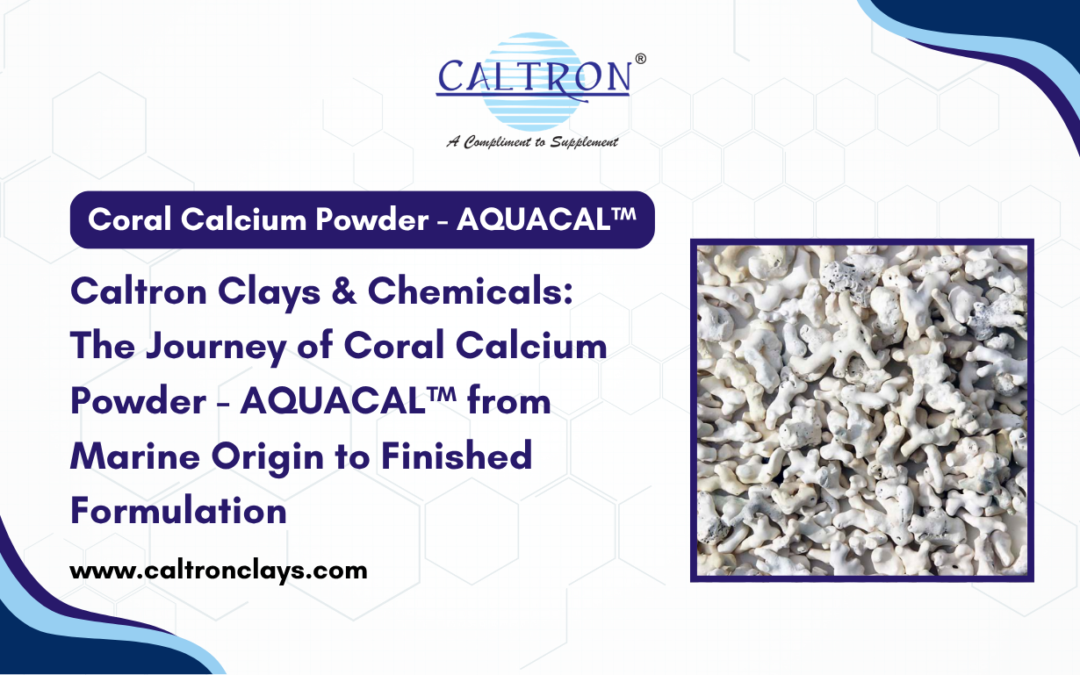
Caltron Clays & Chemicals offers its coral calcium powder under the brand AQUACAL™. According to Caltron’s official product information, AQUACAL™ is produced from dead coral reef material found above the sea/seashore, undergoes beneficiation and quality checks, and has a reported CaCO₃ assay of 99.5%.
For companies searching for a Coral Calcium Powder Manufacturer in India, Coral Calcium Powder Supplier in India or Coral Calcium Powder Exporter in India, understanding the ingredient from source to finished formulation is important. This guide examines that complete journey—from the marine mineral origin of coral calcium to raw-material qualification and its potential use in modern nutritional supplements.
What Is Coral Calcium Powder?
Coral calcium powder is a marine-origin calcium raw material obtained from mineralized coral deposits and composed predominantly of calcium carbonate, together with naturally associated minerals. Its distinguishing characteristic is therefore not simply calcium content but the natural marine source from which the mineral material originates.
Coral structures develop through biological mineralization in marine environments. Over time, mineralized material can form deposits that contain calcium carbonate along with other components originating from the marine mineral environment. After suitable sourcing and processing, selected coral-derived material can be converted into a fine powder for relevant nutritional and formulation applications.
Caltron Clays & Chemicals markets its coral calcium ingredient as Coral Calcium Powder AQUACAL™. The company states that the material is manufactured using dead coral reef deposits found on the seashore and that the coral grade has an assay of 99.5% as CaCO₃.
This differentiates its origin from calcium carbonate grades manufactured through synthetic or industrial chemical processes. The distinction is particularly relevant to brands seeking a natural-source calcium ingredient or a marine-derived story for their supplement portfolio.
However, source alone should never determine suitability. Pharmaceutical and nutraceutical manufacturers must also assess assay, impurity profile, particle characteristics, documentation, regulatory requirements and finished-formulation performance before approving any calcium ingredient.
From Ocean Minerals to Coral Calcium: Understanding Its Natural Marine Origin
The story of coral calcium begins with mineralization in the marine environment.
Coral-forming organisms produce mineralized structures primarily by incorporating materials available in seawater into calcium-carbonate-based skeletal formations. Through this natural biological process, coral structures gradually develop into larger reef formations.
Caltron describes the formation process as tiny marine organisms taking up ionic ocean minerals and secreting these materials into coral formations. The company further describes its AQUACAL™ raw material as being sourced from selected above-sea coral deposits rather than presenting it as material extracted from active underwater reefs.
This distinction matters to technical buyers. When manufacturers evaluate a marine-origin calcium raw material, procurement teams should understand exactly what the supplier means by “coral calcium,” including the physical source of the material and how that source is processed.
Marine origin also creates a different raw-material story from that of highly purified synthetic calcium salts. For some supplement brands, this can support natural-source product positioning. For R&D teams, however, marketing positioning must remain secondary to measurable technical performance and regulatory suitability.
A responsible formulation decision therefore separates three concepts:
- the natural origin of the raw material;
- the verified composition of the supplied ingredient; and
- the permitted claims for the finished supplement.
These are related but not interchangeable.
Inside the Journey of AQUACAL™: From Coral Deposit to Fine Calcium Powder
Converting naturally derived mineral material into a usable supplement ingredient requires controlled processing. Raw geological or biological mineral material cannot simply move from source to finished tablet without evaluation and preparation.
For AQUACAL™, Caltron Clays & Chemicals states that the coral material undergoes extensive quality checks and a beneficiation process designed to remove foreign particles and impurities and bring the material into an acceptable range for human consumption. The company also describes the material as being crushed into an ultra-fine powder.
From a B2B manufacturing perspective, the journey can be understood broadly as:
Marine-origin coral deposit → Raw-material selection → Beneficiation and purification → Size reduction/fine powder preparation → Quality assessment → Raw-material supply → Customer qualification → Finished formulation
Raw-Material Selection
The starting material influences everything that follows. Natural mineral sources can vary according to geographical origin and mineral environment, making source selection an important part of ingredient consistency.
Beneficiation
Beneficiation refers broadly to processing intended to improve the quality or suitability of a mineral material by separating unwanted matter and preparing the desired fraction.
For an ingredient intended for nutraceutical or pharmaceutical applications, this stage is especially important because buyers need a material that meets defined internal specifications rather than untreated natural mineral material.
Fine Powder Preparation
Particle characteristics can influence formulation handling, blending, compression, dispersion and processing behaviour. Caltron describes AQUACAL™ as an ultra-fine coral calcium powder.
Specific particle-size requirements should nevertheless be confirmed through the supplier’s current specification or technical documentation rather than assumed from general product descriptions.
Quality Evaluation
After processing, manufacturers need analytical information to determine whether a batch meets defined raw-material specifications. This is where assay, impurity controls and other applicable quality parameters become important.
B2B Ingredient Supply
Once qualified at the ingredient-manufacturer level, the material still needs to pass the customer’s own qualification procedures before being incorporated into commercial finished products.
This separation between supplier quality control and customer raw-material qualification is fundamental to professional nutraceutical manufacturing.
AQUACAL™ Coral Calcium Powder: Key Characteristics for B2B Formulators
AQUACAL™ combines a marine-derived source with defined product characteristics reported by Caltron.
The official product page identifies several characteristics that are relevant when evaluating the ingredient:
- AQUACAL™ is derived from dead coral reef material obtained from above-sea/seashore deposits.
- The coral grade is reported to contain 99.5% CaCO₃ by assay.
- The ingredient is positioned as non-synthetic in origin.
- Caltron states that the material undergoes extensive quality checks and beneficiation.
- The company describes the processed material as free from foreign particles and impurities within its intended quality parameters.
- Caltron states that care is taken during processing to maintain calcium content and control heavy metals.
- The company describes its coral calcium as containing a naturally occurring spectrum of trace minerals.
- Caltron also states that the product is processed without irradiation/radioactivity concerns as described on its product page.
For a formulation scientist, these characteristics provide starting points for technical evaluation rather than a substitute for the current specification sheet, certificate of analysis or application-specific testing.
That distinction is important. A brand statement such as “marine-derived” describes origin. A CaCO₃ assay is an analytical parameter. A finished-product claim requires an entirely different level of substantiation and regulatory assessment.
AQUACAL™ is therefore most appropriately understood as a marine-origin calcium raw material that manufacturers can evaluate for suitable pharmaceutical and nutraceutical applications.
Beyond Calcium: Exploring the Mineral Composition of Coral Calcium Powder
Calcium carbonate is the principal calcium-bearing component of coral calcium. What distinguishes coral-derived material from a simple description of CaCO₃ is its natural mineral matrix.
Caltron states that its coral source contains a broad spectrum of naturally occurring minerals and refers specifically to 74 minerals associated with the coral deposits described on its product page.
From a formulation perspective, this information should be interpreted carefully.
The presence of naturally associated trace minerals does not automatically mean that every mineral exists at a nutritionally significant level, nor does it justify making individual health claims for each component. Manufacturers should rely on actual analytical documentation when a specific mineral concentration is relevant to formulation, labelling or regulatory compliance.
This creates an important distinction:
Natural mineral complexity is a source characteristic; declared nutritional composition must be analytically supported.
For manufacturers developing marine-mineral supplements, the natural mineral profile can nevertheless contribute to ingredient positioning. It enables brands to differentiate a marine-origin calcium ingredient from a calcium source selected purely for its isolated CaCO₃ content.
R&D teams should therefore assess coral calcium from two perspectives simultaneously:
Technical perspective: What does the material contain according to current specifications and analytical results?
Commercial perspective: Does its natural marine origin fit the intended finished-product concept and target consumer positioning?
A successful product requires both questions to be answered.
Why Purity Matters in Coral Calcium Powder
Purity is especially important for naturally sourced mineral ingredients because their geological or biological origin means the raw material must be processed and evaluated before use.
Caltron states that AQUACAL™ undergoes extensive quality checks and beneficiation to remove unwanted foreign matter and impurities and that processing is managed with attention to calcium content and heavy-metal levels.
For procurement, QC and formulation teams, evaluation should extend beyond a single headline assay.
Assay
The assay indicates the measured amount of the specified chemical component. Caltron reports a 99.5% assay as CaCO₃ for AQUACAL™.
The customer’s R&D team should use the supplier’s current batch documentation when performing calculations for the intended formulation.
Heavy Metals
Naturally sourced mineral ingredients should be evaluated against appropriate contaminant limits for their intended market and application.
Rather than assuming a material is suitable because it is naturally sourced, buyers should review relevant testing data and regulatory requirements.
Foreign Matter and Impurities
Beneficiation is particularly relevant here. Removing unwanted material helps transform a natural mineral source into a controlled raw material that can proceed to further quality evaluation.
Particle Characteristics
Powder fineness can affect handling and downstream manufacturing. Depending on dosage form, formulators may evaluate particle-size distribution, bulk behaviour, flow and other parameters that influence processing.
Batch Consistency
A raw material must work repeatedly, not only during the first development trial. Manufacturers should therefore evaluate whether successive commercial batches remain within agreed specifications.
Documentation
Current specifications, certificates of analysis and other applicable technical or regulatory documents are important parts of supplier qualification.
For B2B sourcing teams, purity is therefore not a marketing word. It is a collection of measurable parameters that need to be evaluated against the requirements of the intended formulation.
Coral Calcium Powder vs Conventional Calcium Sources
There is no universally “best” calcium raw material for every formulation. Selecting a calcium ingredient depends on product design, desired source positioning, formulation constraints, regulatory requirements, dosage format, cost targets and the manufacturer’s internal specifications.
Coral calcium can nevertheless be differentiated from conventional calcium ingredients in several practical ways.
Origin
Coral calcium has a marine biological-mineral origin, whereas other calcium sources may come from mineral deposits, shells, algae, milk-derived materials or industrially produced calcium compounds.
Natural-Source Positioning
For brands developing naturally positioned supplements, the source of the calcium can influence product architecture and marketing strategy.
A coral-derived material such as AQUACAL™ gives formulators a marine-origin option rather than a purely synthetic-source positioning.
Mineral Matrix
Coral calcium naturally occurs alongside other mineral components. Caltron specifically positions AQUACAL™ as having a spectrum of trace minerals associated with its coral origin.
Processing Requirements
Natural-source ingredients generally require source selection, purification or beneficiation and quality control before they can become commercial formulation materials.
Cost and Commercial Considerations
Caltron positions AQUACAL™ as a cost-effective alternative within the coral calcium category.
Actual commercial suitability, however, depends on quantity, specification, formulation requirement, logistics and procurement conditions at the time of sourcing.
Product Positioning
A manufacturer creating a standard calcium tablet may prioritize different parameters from a brand developing a marine-origin mineral supplement.
The choice should therefore come from the product brief rather than from the assumption that one source is automatically superior.
How Coral Calcium Powder Moves into Finished Supplement Formulations
Producing a finished calcium supplement requires much more than purchasing calcium powder. AQUACAL™ begins as an ingredient, but responsibility for converting that ingredient into a successful finished product rests with the supplement manufacturer and its formulation, quality and regulatory teams.
A typical development path can involve several stages.
1. Ingredient Sourcing
The process begins with supplier identification. Procurement teams may search for a Coral Calcium Powder Manufacturer in India, Coral Calcium Powder Supplier in India, or Coral Calcium Powder Exporter in India based on manufacturing location, sourcing strategy, technical requirements and target market.
At this stage, price should not be the only filter. Technical documentation, commercial reliability and the ability to support the intended specification also matter.
2. Raw-Material Qualification
Before commercial use, the manufacturer evaluates whether the ingredient complies with its internal quality and regulatory requirements.
Qualification may involve review of supplier documents, sampling and laboratory analysis according to the company’s quality system.
3. Formulation Development
Once the ingredient is approved for development, formulators determine how it will function within the intended dosage form.
The formulation may include other active ingredients and excipients depending on the finished-product concept.
Coral calcium can potentially be considered in formats such as tablets, capsules, powdered nutritional products and other appropriate supplement systems, provided suitability is established by the manufacturer.
4. Compatibility Evaluation
An ingredient does not function independently once it enters a complex formulation.
R&D teams may need to study its behaviour with other ingredients, excipients, flavours, binders, disintegrants or processing aids depending on the chosen dosage form.
5. Prototype Development
Small-scale trials help establish whether the proposed formulation can be manufactured consistently.
For tablets, developers may assess compression and finished tablet characteristics. For capsules, they may focus on fill characteristics and dose requirements. Powder systems introduce different considerations such as blending and dispersion.
6. Quality Testing
The prototype and eventually the finished commercial product must meet the manufacturer’s defined specifications.
Raw-material specifications do not automatically become finished-product specifications. The final formulation needs its own quality and regulatory assessment.
7. Scale-Up and Manufacturing
A formulation that works in a development batch needs to perform under commercial manufacturing conditions.
At this stage, consistent raw-material supply becomes especially important. Variation between batches can complicate production planning or require additional adjustments.
8. Finished Supplement
Only after formulation, manufacturing and quality-release requirements are completed does coral calcium become part of a finished consumer product.
Finished-product claims must be based on the actual formula, dosage, labelling rules and regulatory requirements of the market where the supplement will be sold.
This is why selecting a capable Coral Calcium Powder Exporter in India matters to companies serving multiple markets. International manufacturers often need not only ingredient availability but consistent specifications and appropriate documentation to support their own qualification processes.
What Should Formulators Evaluate Before Selecting Coral Calcium Powder?
Choosing coral calcium requires a structured supplier and ingredient assessment.
Verify the Assay
Confirm the declared CaCO₃ or relevant calcium specification using current supplier documentation. AQUACAL™ is described by Caltron as having a 99.5% CaCO₃ assay.
Understand the Source
Manufacturers should know whether the product is derived from above-sea coral deposits, another coral source or a different marine mineral raw material.
Source information affects technical evaluation as well as finished-product positioning.
Evaluate Purity
Review relevant impurity and contaminant parameters according to the intended application and destination market.
Assess Particle Characteristics
Do not assume all coral calcium powders behave identically simply because they have similar chemical assays.
Powder characteristics can influence manufacturing performance.
Review Heavy-Metal Requirements
Naturally derived mineral materials should be evaluated against appropriate heavy-metal specifications for the finished product and target market.
Request Documentation
Procurement should coordinate with QA and regulatory teams to determine what technical documents are required before approval.
Evaluate Batch-to-Batch Consistency
Commercial production depends on repeatability. Buyers should consider how the supplier controls raw-material and finished-ingredient specifications over repeated batches.
Examine Supply Capability
The supplier should align with expected commercial volumes and production schedules.
Review Packaging and Logistics
Packaging must protect the raw material through storage and transport. Export customers should additionally evaluate logistics, shipping documentation and import requirements.
Consider Regulatory Requirements
A raw material acceptable for one application or country cannot automatically be assumed appropriate everywhere.
The finished-product manufacturer remains responsible for determining suitability in the intended market.
For an international buyer evaluating a Coral Calcium Powder Exporter in India, this due diligence is particularly important because quality expectations must work alongside destination-country documentation and supply-chain requirements.
Why the Right Coral Calcium Supplier Can Strengthen Your Supplement Formulation
Raw-material selection continues to affect operations long after the initial R&D trial.
A dependable supplier relationship can support more predictable production planning, while poorly controlled variability can create additional work for purchasing, QC, manufacturing and regulatory teams.
For supplement manufacturers, supplier selection may influence:
- consistency of incoming material;
- ease of raw-material qualification;
- repeatability during manufacturing;
- availability of technical documentation;
- procurement planning;
- commercial scale-up;
- inventory management;
- international logistics; and
- continuity of supply.
This is why searching for a Coral Calcium Powder Manufacturer in India should involve more than comparing quotations.
Manufacturers should assess technical competence, quality systems, experience with mineral raw materials and ability to communicate clearly about specifications.
Similarly, choosing a Coral Calcium Powder Supplier in India requires assessing whether the supplier can support both development-stage enquiries and ongoing commercial requirements.
For overseas buyers, the role expands further. A Coral Calcium Powder Exporter in India must fit into an international ingredient supply chain where documentation, packaging, logistics and consistent material quality are integral to procurement decisions.
Coral Calcium Powder AQUACAL™ by Caltron Clays & Chemicals: Marine-Origin Calcium for Modern B2B Formulations
AQUACAL™ is Caltron Clays & Chemicals’ coral calcium powder offered for B2B raw-material requirements in pharmaceutical and nutraceutical markets.
Its core positioning is based on natural marine origin, calcium carbonate content, associated trace minerals and controlled processing.
According to the official product information, AQUACAL™ is made using dead coral reef material sourced from selected above-sea/seashore deposits, undergoes beneficiation and extensive quality checks, and has a reported assay of 99.5% as CaCO₃.
Rather than treating those characteristics as finished-product benefit claims, formulators can use them as technical and sourcing parameters when determining whether AQUACAL™ fits a particular formulation strategy.
Caltron Clays & Chemicals also describes itself as a manufacturer and supplier of pharmaceutical raw materials and states that it supplies pharmaceutical raw materials internationally. Its corporate information indicates experience in natural calcium sources and an international customer footprint spanning multiple regions.
For manufacturers evaluating a Coral Calcium Powder Exporter in India, this combination of product specialization and international B2B orientation can be relevant during supplier shortlisting.
Why Formulators and Procurement Teams Choose Caltron Clays & Chemicals
A calcium ingredient supplier should understand both the material itself and the practical expectations of industrial buyers.
Caltron Clays & Chemicals operates in pharmaceutical and cosmetic raw materials and states that it has more than two decades of operations in natural mineral and calcium-source products. Its website describes the company as a manufacturer, supplier and exporter of minerals, oxides, chemicals and pharmaceutical raw materials.
Experience with Natural Calcium Sources
Caltron’s pharmaceutical raw-material portfolio includes multiple naturally derived calcium ingredients. This gives the company a broader calcium-source focus rather than limiting its activities to one mineral format.
AQUACAL™ Product Positioning
AQUACAL™ provides manufacturers with a coral-derived calcium option backed by a published 99.5% CaCO₃ assay and Caltron’s stated beneficiation and quality-control approach.
B2B Supply Orientation
The Caltron website states that the company supplies pharmaceutical raw materials worldwide and has developed customer relationships in more than 40 countries.
This makes the company’s positioning relevant not only as a Coral Calcium Powder Manufacturer in India and Coral Calcium Powder Supplier in India, but also to businesses evaluating a Coral Calcium Powder Exporter in India for international procurement.
Wider Pharmaceutical Raw-Material Capability
Companies seeking a Pharmaceutical Raw Material Manufacturer in India often prefer suppliers capable of understanding broader formulation and ingredient requirements rather than treating every mineral as a commodity.
Caltron positions pharmaceutical raw materials as one of its core product categories and states that it manufactures and supplies natural calcium sources for international markets.
Likewise, for procurement teams searching for a Pharmaceutical Raw Material Supplier in India, technical product information, quality documentation and supply continuity should remain central to the qualification process.
Transforming Marine Minerals into Modern Nutraceutical Solutions
The journey of coral calcium demonstrates why ingredient origin and finished-product performance must be connected through careful processing and formulation science.
A natural coral deposit begins as mineralized marine material. It is then selected, processed, beneficiated, converted into a suitable powder and evaluated before becoming a commercial calcium ingredient. At the customer’s facility, another journey begins: raw-material qualification, formulation development, compatibility assessment, prototyping, testing, scale-up and finished-product manufacture.
AQUACAL™ sits between these two stages.
Caltron Clays & Chemicals positions AQUACAL™ as a naturally sourced coral calcium powder with a reported 99.5% CaCO₃ assay, naturally associated trace minerals, beneficiation and quality-focused processing.
For R&D teams, this provides a marine-origin calcium option to evaluate. For procurement professionals, it creates a sourcing decision that should include specifications, consistency, documentation and commercial reliability. For product developers, it can provide a differentiated ingredient story where natural marine origin aligns with the intended supplement concept.
Manufacturers looking for a Coral Calcium Powder Manufacturer in India, Coral Calcium Powder Supplier in India, or experienced Coral Calcium Powder Exporter in India can evaluate Caltron Clays & Chemicals and AQUACAL™ against their specific formulation, quality, documentation and sourcing requirements.
To discuss AQUACAL™ specifications, technical documentation, samples or commercial raw-material requirements, manufacturers can connect with Caltron Clays & Chemicals and evaluate the ingredient for their intended pharmaceutical or nutraceutical formulation.
Frequently Asked Questions
1. What is Coral Calcium Powder?
Coral calcium powder is a marine-origin calcium material derived from mineralized coral deposits. It primarily contains calcium carbonate along with naturally associated trace minerals.
2. What is AQUACAL™ Coral Calcium Powder?
AQUACAL™ is the coral calcium powder offered by Caltron Clays & Chemicals. Caltron reports a 99.5% assay as CaCO₃ and describes it as a naturally sourced, processed coral calcium ingredient.
3. Where does Coral Calcium come from?
Coral calcium originates from mineralized coral deposits formed in marine environments. Caltron states that AQUACAL™ is manufactured using dead coral reef material found on the seashore.
4. What is the difference between Coral Calcium and Calcium Carbonate?
Coral calcium primarily contains calcium carbonate, but it differs in its natural marine origin and associated mineral matrix. Conventional calcium carbonate may come from other mineral or industrial sources.
5. Is Coral Calcium a natural source of calcium?
Yes. Coral calcium is considered a naturally derived marine calcium source because its mineral material originates from coral deposits rather than being produced solely through synthetic chemical processing.
6. What is Coral Calcium Powder used for?
Coral calcium powder can be evaluated as a calcium raw material for suitable dietary supplement and nutraceutical formulations, including tablets, capsules and powder-based products depending on formulation requirements.
7. Does Coral Calcium contain trace minerals?
Yes, coral calcium naturally occurs with trace minerals associated with its marine origin. Caltron’s AQUACAL™ product information describes its coral material as containing a broad spectrum of naturally occurring minerals.
8. What should manufacturers check before buying Coral Calcium Powder?
B2B buyers should evaluate assay, origin, purity, heavy-metal limits, particle characteristics, batch consistency, technical documentation and regulatory suitability before approving a coral calcium raw material.
9. Who is a Coral Calcium Powder Manufacturer in India?
Caltron Clays & Chemicals manufactures AQUACAL™ Coral Calcium Powder in India for B2B pharmaceutical and nutraceutical raw-material requirements.
10. How do I choose a Coral Calcium Powder Supplier in India?
Choose a supplier based on consistent specifications, quality controls, analytical documentation, technical support and commercial supply capability rather than price alone.
11. Is Caltron Clays & Chemicals a Coral Calcium Powder Exporter in India?
Caltron Clays & Chemicals positions itself as a manufacturer, supplier and exporter of pharmaceutical raw materials, including AQUACAL™ Coral Calcium Powder, for B2B requirements.
12. What is the CaCO₃ assay of AQUACAL™ Coral Calcium Powder?
According to Caltron Clays & Chemicals, AQUACAL™ Coral Calcium Powder has a reported assay of 99.5% as CaCO₃. Buyers should refer to current specifications and batch documentation when qualifying material.
13. Can Coral Calcium Powder be used in tablets and capsules?
Coral calcium powder may be considered for suitable tablet, capsule and other nutritional supplement formulations. Actual suitability depends on dosage, formulation design, processing characteristics and applicable regulations.
14. Is Coral Calcium better than regular Calcium Carbonate?
Coral calcium should not automatically be considered medically superior to conventional calcium carbonate. Its main differentiation is its marine origin and naturally associated mineral profile; formulators should select a source based on technical and product requirements.
15. Where can I buy Coral Calcium Powder in bulk in India?
Pharmaceutical, nutraceutical and supplement manufacturers can contact Caltron Clays & Chemicals for bulk AQUACAL™ Coral Calcium Powder enquiries, specifications, documentation and B2B sourcing requirements.
Looking for AQUACAL™ Coral Calcium Powder for Your Next Formulation?
Partner with Caltron Clays & Chemicals to explore AQUACAL™ for your pharmaceutical or nutraceutical product requirements. Connect with our team to discuss product specifications, technical documentation, samples and bulk sourcing requirements.
Choose AQUACAL™ — From Marine Mineral Origin to Your Finished Formulation.
Caltron Clays & Chemicals Pvt Ltd
Address: Office No. 211, 2nd Floor, Orbit Premises, Next to Sheetal Banquets, Opp to Inox Plaza, Mindspace, Malad West, Mumbai, Maharashtra 400064 India
Phone No.: 022 3571 9844 | +91 70214 37453 | +91 22 2876 4864
Website: https://caltronclays.com
Email: marketing@caltronclays.com | sales@caltronclays.com
Google Maps: https://maps.app.goo.gl/jCuz1ZCf1iAhzZiH7
Enquire with Caltron Clays & Chemicals today for your B2B Coral Calcium Powder requirements.
Recent Comments